Thursday, May 9, 2013

The strange world of stone terminology .


In the stone world Culture has become not much more than an advertising concept.

Here are some examples of  cultured rock.


What then does Tasteless rock look like? 


Tuesday, May 7, 2013

Custom Rocks - Types 1 and 2


The 'Off Road Rock' is very popular with some of the younger, more 'adventurous' wallers who like to get off the beaten track and get stuck into places where more conventional wallers don't get to.


The 'Sun Dried Rock' is sometimes chosen by those who prefer the concentrated goodness of walling without the little pits and stones or any of the unnecessary moisture.

Sunday, May 5, 2013

General meeting of the new Dry Stone Wall Association of Canada - May 4 2013


Thanks to Parkwood Estates in Oshawa Ontario for providing the space for the newly incorporated DSWAC to hold their information meeting yesterday. Kudos too to Evan Oxland for securing this very appropriate venue as well as chairing the event (as Dr. Carlan Stants was unable to attend) and then showing us around the grounds of the stately home of Samuel McLauchlin (founder of General Motors of Canada) 


The emphasis of the meeting dealt mostly with the upcoming Stone Festival to be held in Alton Ontario on the last weekend in June 2013. Eric Landman gave a comprehensive report on most of the festival plans to date, which included references to the main moongate feature, engineering requirements, festival workshops, camping, various sponsors for stone and beer and tools, as well as giving us dates for festival pre-builds which will be the two weekends prior to the actual  festival. (contact Eric at landmaneric@gmail.com to let us know if you can help out on either of those dates)


The tour round the sunken garden after the meeting was of particular interest. The dry stone retaining walls were a treat to see, as I had only read about them in an essay about the 'Arts and Crafts Movement in Canada' which Evan had written and submitted for posting on our Dry Stone Walling Across Canada website some years ago. 


Most of the historic walls at Parkdale were obviously done by stone masons, not wallers. The builder stones in the walls were made of squared granite field stone, found locally, with copes being large slabs of limestone bedded in cement.  Every stone was skillfully tooled and shaped . While the stonework was all very impressive, and it is true that I am always delighted to discover any 'historic' dry stone walls here in Canada, I found the sunken garden had an unsettled feeling to it due to the prevailing 'showiness' of this particular style of dry stone walling.  It was interesting however to see how well the walls were 'standing up' over time considering the fact that many of the stones were face bedded (shiners) and there was little or no batter (inward lean) to the walls. 


I wonder how much longer these walls will be able hold back the dense rows of encroaching garden shrubs and trees, which were all presumably part of the original Dunington-Grub garden design


Saturday, May 4, 2013

Spring with Plants

The flowers have finally started 'stalking' spring which is very late in coming this year.


*


It seems they love being near the warmth and beauty of dry stone walls.


Thursday, May 2, 2013

Levels of acheivement


Kenny Tauch has been our east coast field director 
with Dry Stone Walling Across Canada for the last 5 years.

Kenny wrote recently to tell us he passed his DSWA level three Part B timed test. We would like to congratulate him. I am posting some of his work today with a description he wrote for us of the various elements of his test.  The photos below show what a fine job he did and what a skilled waller he has become.  

I first met Kenny some years ago when I was asked to teach at a dry stone wall workshop that he was planning to host in his home town of Corner Brook, Newfoundland. He was very eager to learn and and had lots of questions for me about walling. 

His level of skill was demonstrated  in 2010 when he came to our Festival of Stone in Landon Bay Park Ontario to be tested for his intermediate level certification and passed easily.


"This Advanced Level 3 Part B test was taken at the Stone Trust in Dummerston Vermont. A strip and rebuild of 4.5sq meters of retaining wall in 7 hours, no corners required. This particular wall stands about 4' to the base of the copes with one row of troughs at mid-hight. If you look REALLY closely you might make out the blue chalk lines which delineated the limits of the rebuild; the blue chalk stayed untouched and everyting in-between was removed and rebuilt. 

The material is comprised of a variety of types from local sources, mostly field stone with some nice granite through stones."


"The Level 3 Part A feature was built at our stone yard in Pynn's Brook, NL July 2012.  It meets the required special features of high wall and curve and is 10 square meters of face on the outside of the curve.  It has a scarcement about 11" deep sitting on a solid sand base. From the top of this footing the wall stands 7' tall with a batter of 6:1. It has 3 staggered courses of through stones 1m apart. If i remember correctly its weight was calculated somewhere around 22 tons."

"The stone is similar to Pennsylvania Bluestone (a hard sandstone high), which we quarried from the Fished Hills in the Newfoundland Appalachians.  The odd looking cope stones are a load-cast feature which was split in half using feathers and wedges.  One end of the wall is left open as there are plans to extend the wall this summer."


"The Sunken Firepit was built several years ago now and remains among my favored pieces of work. It is made of the same Fisher Hills Bluestone. I like this piece mostly for the intimate functional space it creates.   The smaller wallstone with the large slab benches and paving create a nice blend and contrast in shape and subtle colour."

It is encouraging to see workmanship and levels of achievement here in Canada  coming about in such an unostentatious way.


Wednesday, May 1, 2013

Rebuilding the Past


A two-day hands-on walling course will again be offered by DSWAC on July 28 and 29,  2013 involving the rebuilding of a section of historic dry laid wall at the Farm on the 'Kingsmere' estate, near Ottawa. Students will learn basic elements of dry stone construction as they dismantl a section of damaged wall and reconstruct a traditional section of free standing wall the way it would have looked originally, back in Mackenzie King's day. 
Kingsmere Farm is one of many properties maintained by the National Capital Commission (NCC). The Farm is the official residence of the Speaker of the House of Commons. It is located at Kingsmere  in Gatineau Park in Chelsea, Quebec, near the nation's capital Ottawa.
The residence is so named because of its history as an old farmstead dating back to the 19th century. Prime Minister William Lyon Mackenzie King privately purchased the farmstead as part of his country estate at Kingsmere Lake. When Prime Minister King died, he left the residence and grounds to the Government of Canada  so that future Canadian officials could make use of the area. Many walls were built on the property and now could use some repair. "The Farm" is now owned and operated by the National Capital Commission which is sponsoring this event. 
This is a beginners workshop and requires no previous experience. During the weekend professional waller and Dry Stone Walling Across Canada founder John Shaw-Rimmington will explain the fundamentals of foundation, throughstones, batter, hearting and coping. 

Gourmet lunches will be provided both days. No tools were required. This is a shine and not too much rain event. Though this workshop was fairly labour intensive it is not backbreaking. This will be our fifth time we have organized and run a wall 'rebuild' event at the Farm. Generally the women to men ratio is about 2 to 5.
 
Write john@dswac to register. HST cost will be waived on the $230 workshop fee for those who register before July 1st. 

Monday, April 29, 2013

Wallers and Walls in Wales


Master Craftsman with the DSWA, Sean Adcock wrote to me recently to say he also had a good time our Canadian friend Andre Lemieux who visited and worked with Sean recently before seeing Jason  ( See previous post about Jason and Andre)  

Sean wrote... " Don't suppose its much use but just in case you'd like to add something about the first leg of his tour here's a photo or two of Andre with one of our creations during his stay (Evan and Kenny worked on this site too). 


This one isn't one of mine! It is rubbish that will never last - need to include it in a Rogues gallery, it's just a part of a 2000 year old (yes thousand) hill fort! Imagine how long it would last if built properly. 


 We also visited some of things that the Tour of Walls in June was supposed to go on.  How not to batter a wall (built 1860s), obviously a life limited structure... 


This is a retaining wall in Dinorwic quarry (built so there was enough flat land for the big shed, 100 yards long 40 feet high at tallest)   Brenda and Andre are admiring 
the view. 


A diminutive Andre in front is one of the large incline walls used for lowering finished slates out of the slate quarry in Dinorwic. 


Sean was interviewed recently on BBC radio about how not to build a dry stone wall.


It starts about ten minutes into the program


Saturday, April 27, 2013

Auchtermuchty


Jason Hoffman was back at Auchtermuchty for a couple of days working on some bits and pieces that we couldn't finish in November because of the snow and freezing temperatures.

The arch and big wall are looking fine - the stone is now all nice and clean too.

The landscaping guys are finally laying the patio slabbing too (there was still snow on the site last week so everything on this job has been delayed.

He has our good friend and Canadian stone mason/waller Andre Lemieux staying and working with him for a few days. He's been in Wales working with Sean Adcock, learning to work with the rough stone there. He's now with me trying to get his head around Whinstone and sandstone, and is heading up to stay with George Gunn in Thurso later this week for some Caithness stone problem solving. Jason says he thinks he's having fun!

Friday, April 26, 2013

Hand Bones


AROUND 1.7 million years ago, our ancestors' tools went from basic rocks banged together to chipped hand axes. The strength and dexterity needed to make and use the latter quickly shaped our hands into what they are today – judging by a fossil that belongs to the oldest known anatomically modern hand.
The 1.7-million-year-old Acheulean hand axes were some of the first stone tools. Over the next million years, these chunky teardrop-shaped rocks became widely used before being replaced by finer, more precise flint tips. But how our ancestors' hands evolved into a shape that could make such tools is a bit of a mystery.
Before the hand axes appeared, our ancestors had primitive wrists: good for hanging from branches, but too weak to grasp and handle small objects with much force. And no hand bones had been found to fill the gap between 1.7 million years ago and 800,000 years ago – by which time humans had developed the hands we have today. Now, a new fossil is helping bridge that gap.
In 2010, a team led by Fredrick Kyalo Manthi of the National Museums of Kenya discovered an intriguing bone in the north of the country. Carol Ward of the University of Missouri and colleagues identified it as a third metacarpal, the long bone in the palm between the middle finger and the wrist.
Like modern human metacarpals, it has a small lump at its base – the styloid. This projection helps stabilise the wrist when the hand is gripping small objects between the thumb and fingers. Isotope dating revealed the bone to be about 1.4 million years old. It is likely to have belonged to Homo erectus.
Hand bones of early Homo erectus are almost unknown, says Richard Potts of the Smithsonian Institution in Washington, DC. "Having such a well-preserved specimen begins to answer questions about hand evolution," he says.
"This is an exciting find," agrees Mary Marzke of Arizona State University in Tempe. It shows that our ancestors' hands were already evolving into their modern form 1.4 million years ago. The forceful, repetitive and sustained processes of tool use, such as digging with rocks, would have made stronger hands desirable, says Marzke.
This would have been particularly useful for knocking off flakes to form and sharpen hand axes, says Potts. Once the important wrist features were in place, it became easier for later hominids to make smaller, finer tools.
Because the fossil is younger than the first tools, Ward's team believe it is the first evidence of anatomy evolving to suit a new technology. As stone tools became more widespread, those who had the wrist structure to use them would have had an evolutionary advantage over their weaker-wristed kin. "The way we look today has been shaped by our behaviour over millions of years," says Ward. She presented the research at this week's meeting of the American Association of Physical Anthropologists in Knoxville, Tennessee

Thursday, April 25, 2013

Greetings from the Board


Greetings from the Board of the recently incorporated Dry Stone Walling Association of Canada

The Board would like to cordially invite you to a meeting on Saturday, May 4th, 2013 1:00 PM to 4:00 PM Parkwood Estates 270 Simcoe St N, Oshawa, ON L1G 4T5
The purpose of this open social event and meeting is to inform dry stone wallers and interested parties of the Association’s activities to date and upcoming planned activities. In particular, we would like to provide information on the Association’s new Standards and 

Events guidelines and the Association's upcoming inaugural 2013 Stone Festival, in Alton, Ontario from June 28th - July 1st.
We hope to garner your ideas for the Association’s future direction, as well as encourage new membership. You need not be a member to attend this meeting. After the meeting, we will reconvene at a local pub for dinner and drinks.

2013 Stone Festival
We have formalized arrangements with the Town of Alton, who have agreed to be the host of our inaugural 2013 Stone Festival. The Town of Alton has a Trillium Grant from the Province of Ontario for the event. The Association been asked to build several sections of wall, a pillar, and a feature which will consist of a moongate with a bonsai metal sculpture embedded in its centre in a new Town Square.
We will also be conducting a beginner’s course taught by certified craftsmen.
The Dry Stone Walling Association of Great Britain, The Dry Stone Conservancy and The Stone Trust have all agreed to send representatives to the 2013 Stone Festival. All of them will participate in the builds; provide a presentation on their organization and activities; and to participate in Certification Examinations.2
Dry Stone Walling Association of Canada Invitation 

Guests to the festival include
Norman Haddow and another master craftsman from the DSWA-GB.
Neil Rippingale and Jane Wooley, The Dry Stone Conservancy, 
A master craftsman fromThe Stone Trust

The Association has chosen to invite members from three of the most influential walling organisations as both an outreach to more formal relations and to solicit a varied perspective with respect to education, standards and governance. All three organizations are very well recognised, respected and their members include some of the top wallers in the world. Their representatives will be involved before, throughout and after the 2013 Stone Festival weekend in preparation, education, and certification.

Lunches will be provided for all registered participants. On the Saturday evening there will be an open dinner with the town for all registered participants.

Volunteers
The Association has 2 pre-builds for which we need volunteers. These pre-builds are on the weekends of June 15th/16th and June 22nd/23rd. Accommodations and lunches will be provided for during the pre-builds. Please contact Eric Landman at landmaneric@gmail.com if you can help.
If you are interested in getting involved with the administration of the organisation we could greatly use ANY help, please contact Carlan Stants at drstants@ymail.com if you are interested. Some working groups that need support/activity include the Events Committee, Standards Committee, Website Committee, and Membership “The Great Catalogue of Wall” Committee.

Tuesday, April 23, 2013

Do we know how to draw them?

*

We build walls with stones
We build bridges of stone
We make roads and driveways of stone
We blast stones to make roads
We buy stones
We collect them
We are sometimes a stones throw away
We sometimes throw stones at glass houses
We skip stones
We play games with them
We balance them
We paint pictures on them
We keep doors open with them
We prop things shut with them
We carve them
We sometimes have a heart of stone
We have stony expressions
We stonewall people
We get stoned drunk
We stay stone sober
We can be stone broke
We can be stone cold
We can ignite a fire by hitting stones together
We had a stone age
We live on a planet mostly comprised of stone
We have wonders of the earth made of stone

But trying to draw or paint stones...
It's really not that easy.


Monday, April 22, 2013

Formally Dressed

I'm proud of Jason Sivak of Sivak Stonemasonry. He and his crew not only have a great talent for doing both quality and inspiring stonework, they have a sense of humour too. Jason and I think alike. 

He writes, " After years of wearing jeans and t-shirts to work, the men of Sivak Stonemasonry decided it was OK to class things up for one day a week. Starting the Formal Friday Tradition." 

Bravo guys ! 


Jason not only scores stone but scores big style points with his tan suit and blue shirt.

Fezzy, even while cutting a stone stays professional in his pinstripe navy suit.


Mickey pulls a stone from his pocket while pulling off a classic gray suit with red tie for some color.


As for me? I've been walling in a tweed jacket for years.


I'm always trying to dress things up a bit with the guys I work with -
But they just don't get it.


Saturday, April 20, 2013

Grampians National Park Trail Project - Part Two


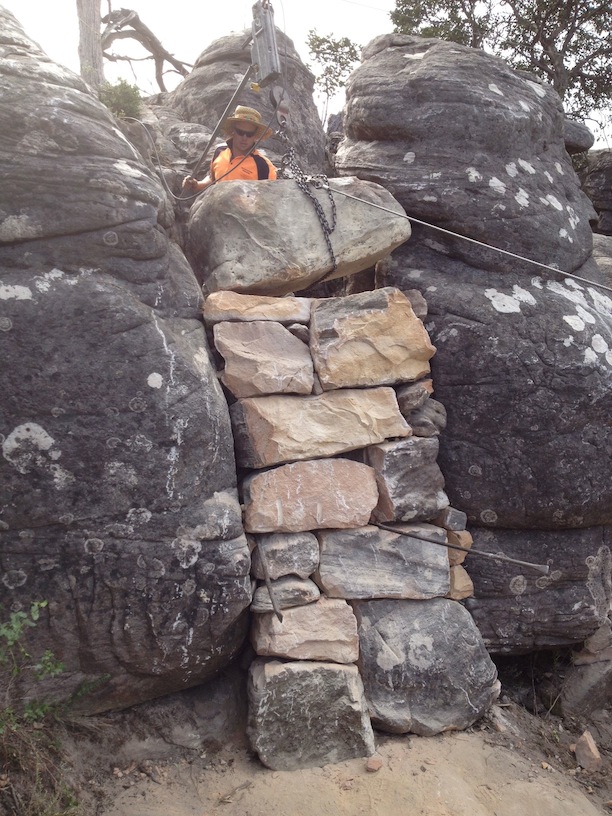
An overhead rigging system was also set up in order to lift the heavy wall and step rocks into place. 


It took a some deliberation to figure out the best alinement for the stairway, and in the end we opted to take advantage of a large column of rock that had partially cleaved from the main ridge and created a gap that was ideal for containing the planned stairway.


For this to work, a 10 foot high retaining wall needed to be built on the side of the column where the trail left the ridge, with a further three and a half foot of free-standing parapet extending above the retaining wall to remove fall height issues for walkers.


The site was about a 45 min walk from vehicle access and approximately 270 kilograms(600 pounds) worth of tools and rigging equipment had to be hiked in and out on our backs. 


As is evident from the photos, with the moving of large rocks and proximity to fall heights, the potential for a serious accident was present. 


Constant vigilance and adherence to safe work practices were followed in order to reduce this to an acceptable level. I am very grateful to my two assistants Thor Delager and Caillan Sainsbury for their help in successfully completing this logistically and technically challenging project.