They say a good waller picks up a stone once and then puts in the wall. To keep picking it up and putting it down again isn't efficient. Upon reflection, this seems to make sense. Each time you pick up the same rock you're expending a greater effort and building a bigger imaginary wall than the one you finally end up with. The accumulative effect of the stones, as they are moved and removed, and fitted and refitted, not only slows you down it weighs you down. 

There are not many American beers I like. So many of them seem tasteless and watery, way too weak . Either that, or they go overboard celebrating 'hoppy hour'. I prefer a beer that doesn't have a grapefruit peel aftertaste. Tried this one because of the name. What are the chances? It's brewed out of Fort Bragg, quite near to where we are. It's got a nice un-hoppy flavour. It goes good with stone chips, rock dust and rosy lingering California sunsets. I know the world is full of all kinds of pain and injustice, but is it so wrong to just be thankful to be alive and at the end of the day enjoy a little bit of un-hoppyness?


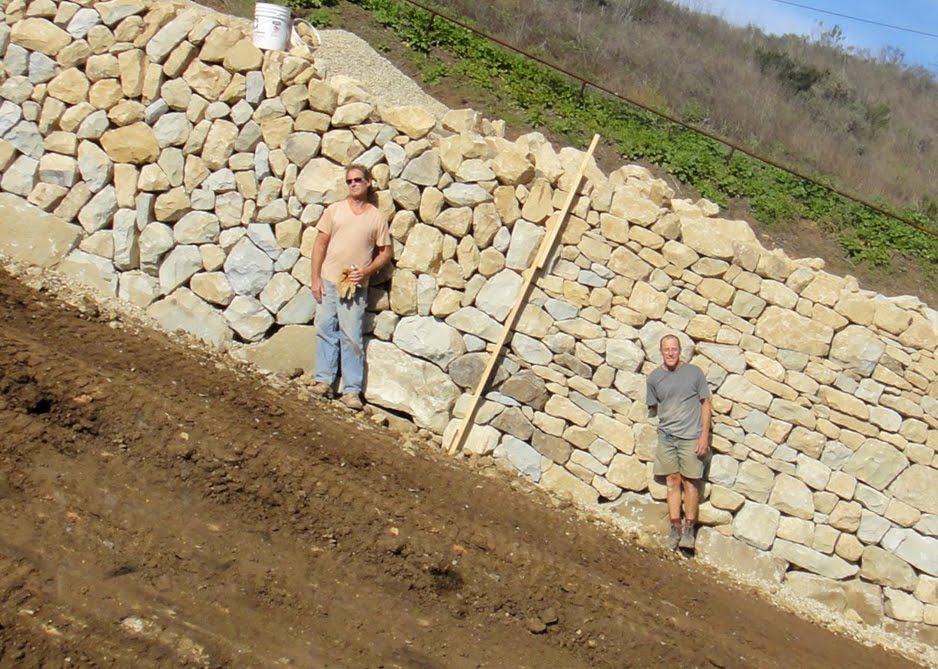
Sean Adcock likes the steepness of his part of our wall. It rises at a cute angle. Yesterday the stone placement was hard to catch on to. It was so difficult to do that Sean and I thought we were slipping as wallers. It was such an uphill battle. Today the degree of our skill level has increased. The angle is still kind of challenging but so far neither we or our stones seem to be slipping. Sean sits down at the end of a good day and gives his 'ascent' to being photographed.


Une arche en pierres sèches parmi les milles îles Après une semaine de travail rigoureux, l'idée de se retrouver apprenti auprès de l'un des maîtres canadiens dans l'art de construire des murs en pierres sèches pendant deux jours me plaisait bien. L'objectif pratique de cette fin de semaine était d'ériger une arche de pierres de huit pieds de hauteur (sans mortier ou béton) au «Biosphere center» situé dans la belle région des Milles îles, en Ontario. L'ouverture de cet atelier s'est faite lors d'une journée pluvieuse du mois de mai, sous un mercure qui n'a pas voulu dépasser les 5 degrés. Tailler et travailler la pierres dans ces conditions météorologiques aurait rebuté n'importe qui, mais les yeux scintillants et l'énergie dégagée par celui qui allait nous dévoiler les grands secrets de la pierre en valaient largement la peine! John Shaw Remmington, un maçon de formation au sommet de son art et instigateur du «Dry Stone Wall Association of Canada», a délaissé il y a belle lurette, le mortier et le béton pour renouer avec les techniques traditionnelles et ancestrales de pose de pierres. Les artisans de cette association créent des murs, des bâtiments et même des ponts de plus de quatre mètres de portée sans le moindre mortier! Des ouvrages qui laissent les visiteurs sans voix! En Estrie, la pierre reprend tranquillement sa place à travers nos paysages et je crois que nous pouvons tous nous en réjouir. L'impact écologique est beaucoup moindre qu'un produit de béton (surtout si la pierre est récoltée localement, il va sans dire), l'intégration plus harmonieuse et enfin, chaque ouvrage de pierres fait appel à un certain sens artistique. La pierre offre cependant plusieurs défis: apprendre à lire, comprendre et respecter la pierre avec laquelle on est appelé à travailler est fondamental pour la pérennité des ouvrages à réaliser. Pour l'instant, ces ateliers sont offerts uniquement en Ontario, mais ne laissez pas ce détail freiner vos envies de léguer des ouvrages de pierres à vos petits et même petits‐petits‐enfants! Cette aventure est ouverte à tous ceux et celles dont la curiosité et la soif d'apprendre ont comme chez moi, un caractère insatiable. Les ouvrages de pierres sont immuables, mais les connaissances et les apprentissages voyagent et n'ont de limite que l'imagination et la bonne volonté de leurs propriétaires! Et puis les Milles îles, c'est une si magnifique région! Aaron P. Wallis (architecte paysagiste, M.Sc A) Parution : Le Reflet du Lac – 27 mai 2010


Art City in Ventura California is an urban island where stone and stone artisans meet. The art of working with stone thrives here and morphs and transforms into a crecendo of imaginative projects involving every combination shape colour and texture of the rocky stuff we wallers merely stack in rows. It manifests itself in many different sculptural forms here- rough natural and smooth and highly polished. Water may flow from it. It might be a figurative baslt tower a delicate alabaster bust an animate marble lifeform or a weird and wonderful montage of found stone artifacts and tailings. It is a place where people are thinking with their handsPaul Lindhard is the humble motivating force behind this amazing wonderland of stone. He is also the sculptor, businessman, teacher,and co-facilitator of this and last year's Stone Symposium. The carving workshop was based on the Art City property and was taught this year by well known British carver Nicholas Fairplay. Nick gave a wonderful presentation on Tuesday showing many amazing examples of the intricate carviings he has completed in such important places as Hampton Court and St John the Divine Cathedral in New York
Yesterday morning several of the Stone Foundation Symposium participants took a field trip to Stone City. I was admiring the stone 'contour' piece (shown above) and happened to bump into the artist who created it. He explained how the piece had to combine elements of a sculpture and also be a pathway where foot traffic and wheelchairs could safely pass. It was made of thousands of hand picked stones he had brought back from the beach. This undulating pebble mosaic by Kevin Carman reminded me of a miniature crevice garden. It also was reminiscent of some of the intricate historic pebbled pathwork I saw in St Andrews in Scotland.

Kevin's website is kevin-carmen.com


Raphael and Lluc part company after six days of intensive building. Raphael is the amazing heavy machine operator who helped move the biggest stones and move dirt and deliver material to the wallers at the Ventura 2011 Stone Symposium Workshop. Lluc flew in from Mallorca Spain to be one of the four instructors, each doing 25 feet of wall nearly ten feet high. He worked very hard and his energy and enthusiasm was infectious. In fact, there was a wonderful sense of harmony and cooperation between the two dozen or so people involved in this massive project. Everyone learned a lot,met up with old friends and made new ones. No one got hurt during the workshop. No body was mean spirited, rude or critical. The peace sign Raphel made with his hands in this photo says it all.
In California it seems they really like to encourage stone balancing. Luckily the state has enough quality recreation and costal resources for anyone to try their hand at it. I usually 'build', not just 'balance', with the stuff. I've never thought of myself as a 'resource mason', or a 'dry quality-recreation waller' but I'm always looking for new ways to describe what it is we do. 
Tomas Lipps, director of the Stone Foundation and organizer of this year's Symposium in Ventura California, (and the man responsible for putting together nine other international stone symposiums since 2000, held in various stone-related places throughout North America and also in Spain) holds up a hammer he has just had fabricated by Trow and Holden. It is modeled after the Mallorcan hammer we were introduced to when the symposium workshop students were taught a very different method of shaping stone and walling back in 2007 in Deia Spain. The hammer is a hefty seven pounds in weight with an 18 inch handle and a rounded indentation in the head so that it has an edge on all four striking planes. It seems to do a good job of knocking off edges and making nice faces in the sandstone we have been working with this week. Lluc Mir who is here from Spain teaching one of the Ventura workshops likes this 'knock off' of the type of hammer he is used to working with, but suggests the handle could be even longer.
These men put in a long day putting in big stones in our long wall that is being constructed in Ventura this week. The sandstone is gritty and tough on the hands. The pieces are big and awkward. There is still lots to do in the next four days and there are four somewhat different techniques of walling being taught. The size of the project and the mix of walling skills is making it a challenge and very much of a new experience for instructors and students alike. During supper at the pub there were techniques and new ideas to discuss about why certain stones were being placed and fitted they way they were. That things were actually being done is the important thing. It is very satisfying to stand back see the work of our hands rather than sitting on them and having very little to show .