Thursday, January 10, 2019

Stone Love


Having been asked how he and Rhonda (the roundish stone ) had met, the Squire, (the squarish stone) launched off on an epic tale about their romantic past.

"Many many years back, Rhonda left the glacier and eventually ended up living on the west coast of what was not yet England, not far from what was to become town of St Bees. She spent all her days on the beach sunning herself, listening to rock and roll ( the sounds of tumbling stones and smaller pebbles being rocked back and forth by the ocean waves) and enjoying the constant changing of the seasons. 
Years passed and much of the surrounding coastline eroded away - in one area exposing the high red sandstone cliffs now known as St Bees Head. Rhonda had been fortunate enough to keep her place on the coast though many other rocks living closer to the ocean had come and gone."

"Finally," he said "some time after that, humans came on to the scene. They gradually moved into the area." 

The Squire was guessing, about 3000 years ago. "That's right, isn't it, Rhonda?"

"You're telling story dear, I'm going to stay out of it."

"Well anyway from that time on, from what I gather," said the Squire, "Rhonda didn't have a dull moment. She was often picked up, sometimes two or three times a day by various strangers passing by along the beach."

"I never minded the attention." Rhonda added.

"Many years passed, and Rhonda enjoyed the reputation of being one of the oldest residents along that part of the coast"

"But go on, tell the story about the big storm."

"Yes well," returned the Squire, " here is where I come into the picture. Some time later, I'd say back about 175 years ago, while I was sailing from North America in the hold along with a lot of other granite ballast, we strayed from our course and ended up running aground not far from Whitehaven. Running aground was tough break for the ship and the crew, but it was a nice break for us. I spent a good few years enjoying a long relaxing ocean-bed holiday."

"The storm, dear."

He paused again, looked at the rain and then launched into her favorite part of the story.

"At the turn of the century a very big storm blew in off Iceland. There were huge great breakers the size of small mountains, smashing into the shore. It churned the coastline waters up so violently many of us were washed up onto the beach."

"We ended up meeting and falling in love."

"I believe you wanted me to tell the story dear?"

The Squire went on  "I had been cast up onto the briny shore only to find myself lying beside the most beautiful piece of rounded granite I had ever seen in my life. "

"You were quite a hunk yourself"

"I knew it was going to be the start of a lovely long 'rocky relationship'. Oh, It was quite 'Tectonic' at first, of course . We discussed how far the continental drift had strayed, and how the earth's lithospheric crust was made.

They both sighed and looked at each other adoringly. 

"We talked of many things," Squire mused as Rhonda gazed off dreamily into the hills.

"Of shale and schist, and sealing cracks
And amethyst and slates
And why debris forms mountain scree
And why the earth has plates

We spoke of sub-atomic mass
Of particles and strings,
Of quantum leaps and isotopes
And earth's magnetic rings."

The Squire stopped and took a breath. "Things started to develop fairly quickly after that."


To be continued

Monday, January 7, 2019

Blind Folded


You can't stop that special stone from seeing. You can try to blindfold it but it still sees everything. And it still looks at you in that all knowing stone-like kind of way. It doesn't have to say anything. 

You can try to pretend you don't see it. Or rather, ignore the feeling that you have this sense that you both have some sort of special connection. You can try to imagine you don't need it. And that you can walk past it on the beach. 

Or you can think that you can just cast it off into the lake, and be done with it. 

Or better yet, bring it home and put it on a shelf, and that will be enough. Maybe write something on it. Draw over it.  Maybe just cover it completely with paint?

But in the end it still sees inside of you. It knows you better than you do. Because the connection is there. 


Sunday, January 6, 2019

Folded Hands


I close my eyes and fold my hands
My fingers turn to flattened strands
They bend in grooves along each digit
And thus I have no way to fidget

My folded hands, I must confess
Look stranger yet, when more compressed
They buckle in and merge in layers
And thusly poised, I say my prayers

I find my words more concentrated
With hands thus bound and laminated
I know not how to unclasp them 
I have no strength to ungrasp them

But when my words have all reached heaven
I thank the Lord, and say 'amen'
For when I open up my eyes
The folds are gone, to my surprise.


Saturday, January 5, 2019

Sheep Folds


There are sheep in the folds
And folds in the sheep.

Pressed 
But not oppressed 
Safe in snuggly sleep

Fitted sheeps 
Tucked into corners 
To keep them from
Their sheepish fits.

No wrinkle of danger 
No cause to be afraid 

Rocks with flocks 
Hemmed in at every stage 
      So as not to in crease their chances of wandering straight off the...
page.

Origami walls and ledges 
Neatly wrap the outside edges
From the straights
And from the narrows 
The sheep all safe from
Slings and arrows

Folded wooly blanket coziness
Enclosed and fully flanked in stoniness 
A shelter from unruly wind and cold
As safe as in the days of old.


origami 'mouton' by Beth Johnson
poem and illustration by me


Thursday, January 3, 2019

Folded Into Itself


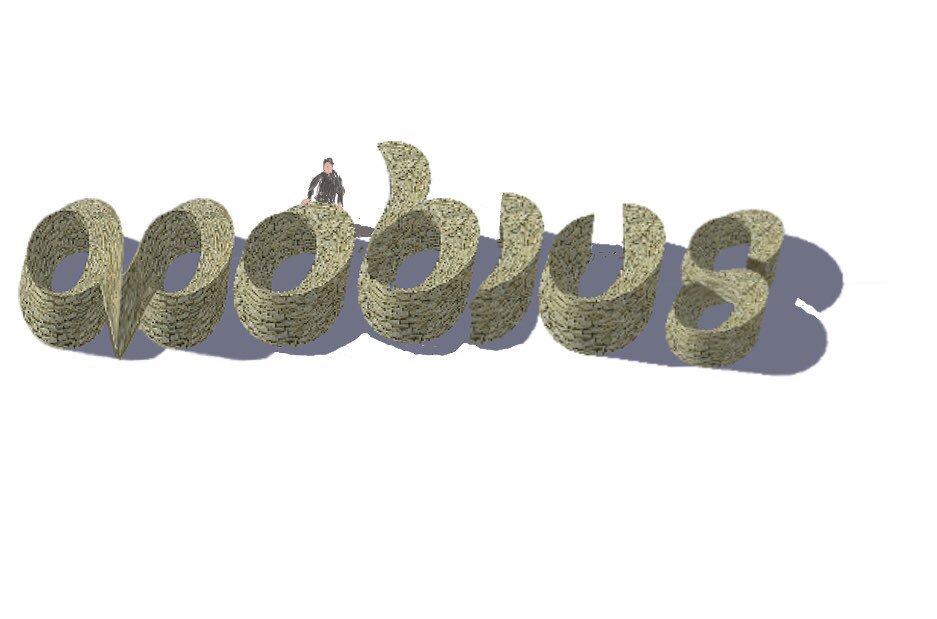
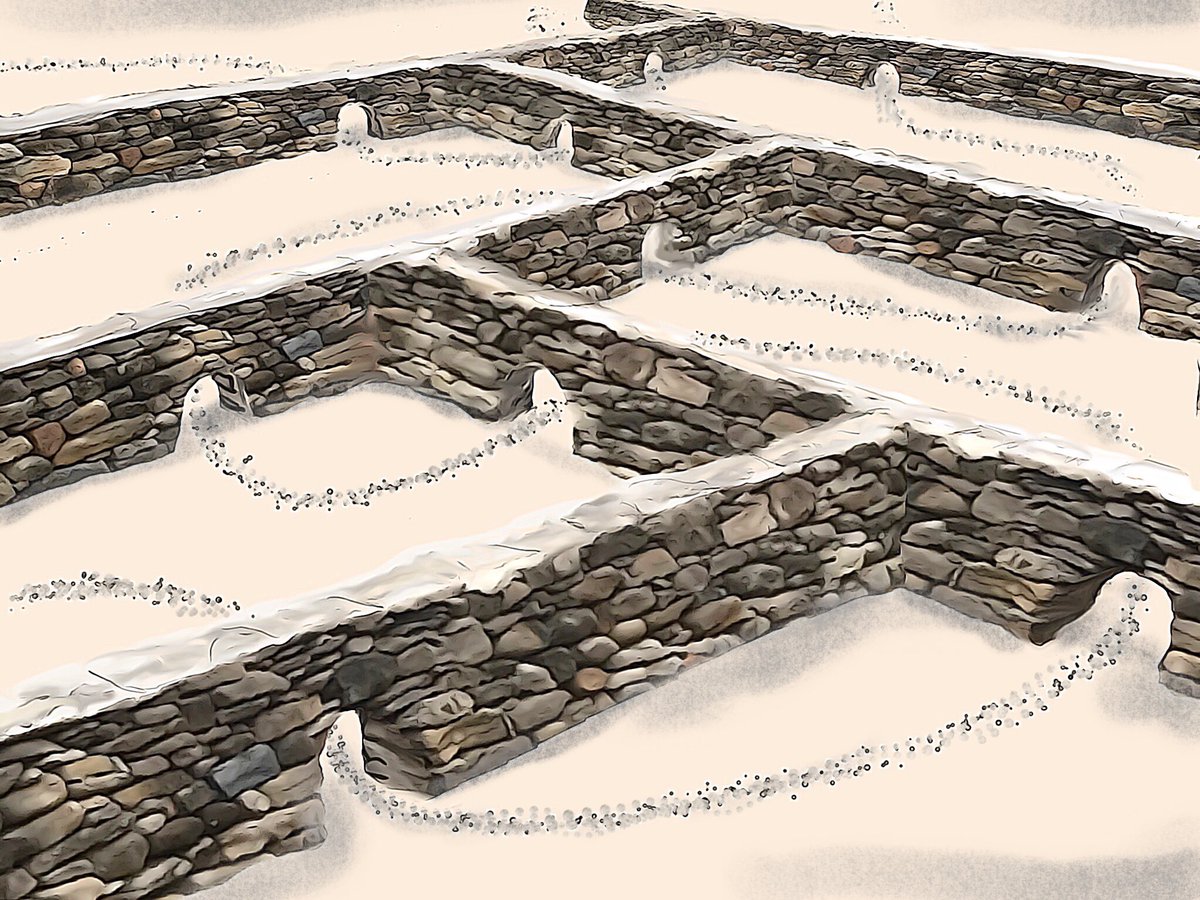
The Mobius Strip is an inviting shape to try to use in a dry stone wall design. It is a wall with only one side. It circle/spirals around as it folds into itself. It's a surface that continues becoming the top, the side, the bottom, the side and the top again.

We could be at the top of our game and still really only be at the bottom (the 'game' being our work) if we only built mobius shaped structures. 

How would we know? 

Like much of life, top and bottom are often the same side of the same thing. 


Tuesday, January 1, 2019

The layers keep folding over.


Folds are one of the most common phenomena you can find in geology. A fold is usually produced by plainer layers (usually sedimentary rocks) which are curved by sympathetic efforts. The kind of folding in the photo below is called a Chevron and its main feature is that the angle of hinges is very acute, almost without curvature. The undoctored photo (below) is of a completely natural stone fold formation found in Greece.   The image was found on Geologiaaldia's Instagram feed. 


Thursday, December 20, 2018

Openess


Is there such a thing as being too positive ? Too cheery ? 
There's no time like Christmas to find that out, I guess. 

I look at the photo of the snowy moon-gate we built at Sara's Garden and am reminded that the 'negative' space, created by the positive mass of dry laid stones, could be imagined intermittently, as either just a beautiful solid wall, with a Christmas tree decoration on a glass ball suspended in the foreground, or, seen (more likely) as a circular snowy positive opening with the tree in the background . Both perceptions give the whole thing a feeling of festive cheer. 


In essence, it looks like there could be an extension to the maxim "two negatives make a positive". I realize rather cheerily that a positive AND a negative can create a beautiful positive, as well.  Is that being too positive?

Wishing all you souls a Happy Solstice, and an open mind to the variety of wonderful experiences and opportunities that come your way over the holiday season.

 See you in 2019 !

Friday, December 14, 2018

A Foot in the Door


Sometimes the scope of a project is left undetermined. This can be, and often is, a mutual arrangement between client and artist. It is agreed the wall can go on and be built longer, later. More retaining walls and terraces can be 'talked' about in the future. 
Usually for me the first project is the dry stone 'foot in the door'. Not literally, of course. Good work begets more good work. 
But one day, if it there was the right setting for it, I think there could be an opportunity of putting a dry stone foot in the doorway somewhere. And then, of course, it could be gradually added to, in the future.

Sunday, December 9, 2018

The wall stays


Farley is sitting in front of a wall we built over 14 years ago. No,Farley didn't build it. He wasn't there.

It was Steve Fraser and Matthew Ring who successfully completed their DSWA certification tests doing two separate sections on it, and then later I built another 20 feet connected the sections and finished off the west end of the wall.

A newly hired employee with the town, director of works,  drove by the day I was finishing up and told me the wall, though set well back from the road, was on town property and that it had to be taken it down.

The owner of the property went to the town and requested that it not have to be taken down, as for one thing,  it acted as barrier to keep his children safer in the front yard. (A car had the year before careened into the wire holding up the telephone pole on the front lawn where his children were playing) 

Also, there were many trees and other walls and fences much closer to the road that the town had not required to be taken down.

I found out that in that meeting the newly appointed town official put his foot down and said to the then council. "Either that wall goes or I go."

The town was in a funny position. Anyone who saw the wall loved it. Petitions were signed. Wallers from around the world wrote to try to save the wall. A publisher of a stone magazine wrote and asked that it be spared and added that if the town would be so silly to have it dismantled, he was going to come personally and do a story on it, as a way of exposing such a municipal folly.

The controversy of the wall went on in a kind of muted way for years. The people who owned the house were told they had to take out special insurance on it. Each new owner of the property still has to take on this cost.  

Suffice it to say, as you can see from this photo, the wall is still there and, I heard just recently that the town employee vacated his job. I looked it up and read yesterday on line in the archives of a local paper, that he left "without any explanation" in 2017.    

Saturday, December 8, 2018

O Holy Rewrite


Don’t hold them tight, 
The stones are partly frozen.
I’m not dressed right and I can’t find my glove.

Long days at work, my eyes are semi-closin’ 
I should go home, yet I haven't built enough. 


I'm filled with hope.
I've sent a few invoices.
I might get paid, for work I've done this year.

Waaall ---- on your knees !  
Don't make those achy noises.
Try-not, to whine, 
At least one glove is here.

Tonight I'll-freeeeeze !
Tonight, 
It's minus nine!


Wednesday, December 5, 2018

Inside a Stone


The number of stones in a dry laid wall is finite.
However, it is impossible to count how many walls are contained in a single stone.

Monday, December 3, 2018

Lives and Forks


Two roads diverged in a wood,
and I—
I imagined a dry stone 'fork' there.
And that has made all the difference.


(with apologies to Robert Frost)
        

Friday, November 30, 2018

Monday, November 26, 2018

What it seems to be.

I


Yesterday's image was a photo of a 'seamless tile' stone texture. In other words, the image is manipulated so that it can be used in multiples of itself to create a continuous surface, without it appearing to be a repeating pattern. In this case the surface of cracked rock has a random feel without any sense of it being multiples of the same thing

However, the further away you are from the screen (and the smaller the tiles become ), the more obvious it is that you are seeing a repeating pattern. 

Conclusion?

There is a correlation here between standing back from the thing (vision? perspective? insight? years of experience?), and seeing the possibility of recognizing some sort of controlled pattern, even though others, less patient or maybe less skilled, may only see a random unstructured mix.

This is perhaps an explanation of what we do as wallers. We see the pattern of the wall, within what seems to be at first, just a random pile of stones.


Sunday, November 25, 2018

Can you see it?


There is an integral pattern contained in this rock formation photo. Do you see what it is ?

Saturday, November 24, 2018

New Bookends


Our dry stone section of curved 'test' wall, which was built between two large redwoods some years ago, has received treemendous feedback. It was built as an experiment to see if an entire circle, with a similar size arc, built in this upright style, would work in a future installation at the Gualala Art Center. The wall and the concept looks and works better than we anticipated.

The only problem is that the tree on the right moves a bit too much in high winds,hence a few fallen stones have to be put back each year. 

The fix is easy. With the help of a large extended arm forklift (a telehandler Gradall) we've replaced the tall tree 'bookend' scenario with two heavy basalt columns instead. The process of re-situating of the test wall between these new massive bookends now begins. 

We will come back in January to take on the bulk of the task.  The challenge will be to rebuild everything as beautifully and as magically as the first time. This requires our somehow being in the 'stone zone' again. 

Thursday, November 22, 2018

How to lose those porta-loos ?


Just because it's a special outdoor event doesn't mean those ugly plastic toilets have to be front-row centre, in fact why  have to look at them at all? A beautiful, dry stone, L-shaped partition wall will keep such unsightly things discretely out of view. 


A section of dry stone wall built tall enough to hide a couple of portable toilets is the perfect answer. Once it's built, it will still continue to be a visually pleasing structure the rest of the year. And when the time comes and it's needed again as an aesthetic bar from the madding crowd and the inevitable 'call of nature' - just say, 'toodle loo' to the loo.
------------------------------------------------

DSWAC will be holding a dry stone 'porta-partition' wall workshop on the first weekend in June of 2019 at ZimArt outdoor gallery, which happens to be their 20th anniversary celebration opening.

Cost - 200 dollars, includes lunches, drinks, HST and printed material. Limited to ten students.


Visit
Canada's Premier Zimbabwean Stone Sculpture Gallery
Founded 2000
705.939.6144

Wednesday, November 21, 2018

My next variation on the sturdy leaning 'picket fence' stone wall concept. ©


My newest application of the sturdy leaning 'picket fence' stone wall concept we built on the west coast, is based on a photo I saw of super fit bathers on the beach demonstrating a group yoga 'exercise' somewhere near the ocean too. I'm thinking that stones could be 'fit' in a similar configuration, to make a very pleasing variation on our latest installation we recently built in California.  


Tuesday, November 20, 2018

Overlooking the scenery


We’re home now from California.

Strangely, the reality of having constructed a dry stone wall right on the Pacific coast hasn't really sunk in yet.

Maybe, over the next few months, my trying to describe to people the beauty of where we were working, I'll be able to grasp the whole thing better myself.  The significance of the experience, the drama, the ‘thereness’ of it all, perhaps will be better realized as I continue to try to look back on the amazing experience it seems we had there. 

Just to think about it - we built a permanent structure inches from a 70 foot cliff overlooking a crashing ocean below. We literally ‘overlooked’ so much of it ( both opposite meanings of the word ) during the two weeks we were mostly concentrating on getting this pretty unusual stone fence built during the time we had allotted to complete the project. 

I wonder now, did others, perhaps a long time before us, building any of the old wooden livestock fences I’ve seen along these coastal regions, also ‘overlook’ the immense import of it all?  Did they stand there in amazement a lot of the time as they were working, or did they mostly work on as usual, as they dug holes for the wooden posts and hammered the rails and nailed the pickets, close to the edge of the sea?

And then I think, what about all the people who have worked building other stone structures in spectacularly beautiful parts of Britain and Ireland ?   We’ve all seen the photos of bridges built over wild tumbling streams  - and beautiful walls jutting out from fantastically magical landscapes - and stoned terraces tracing contours of breathtaking beauty. Can we just assume the people who built these structures were able to appreciate where they were?

Did they all, returning at the end of the day, or the end of the job, say “ Wow, what a seriously cool thing that was ! ”
Did they talk of it years later, recounting, almost reliving for the first time, what a powerful, exceptional experience building in that scenic place back then, was?


I wonder.


Monday, November 19, 2018

Sunday, November 18, 2018

Like a fence in the headlights


Thanks to Gwen, who drove some distance to see it, arrived very late, but sent this photo of our lighthouse stone wall, lit only by her headlights.

Friday, November 16, 2018

Returning to the shore with Stones


How many times have you come to the beach and picked up stones to bring home? But have you ever brought stones to the beach in order to leave them there? 

These mica schist slabs were brought to and left in this order along a short stretch of coastland by my crew and I last week, and then we returned home, 'stoneless'.

Wednesday, November 14, 2018

Is it a wall or a fence?


Is it a wall or a fence ?
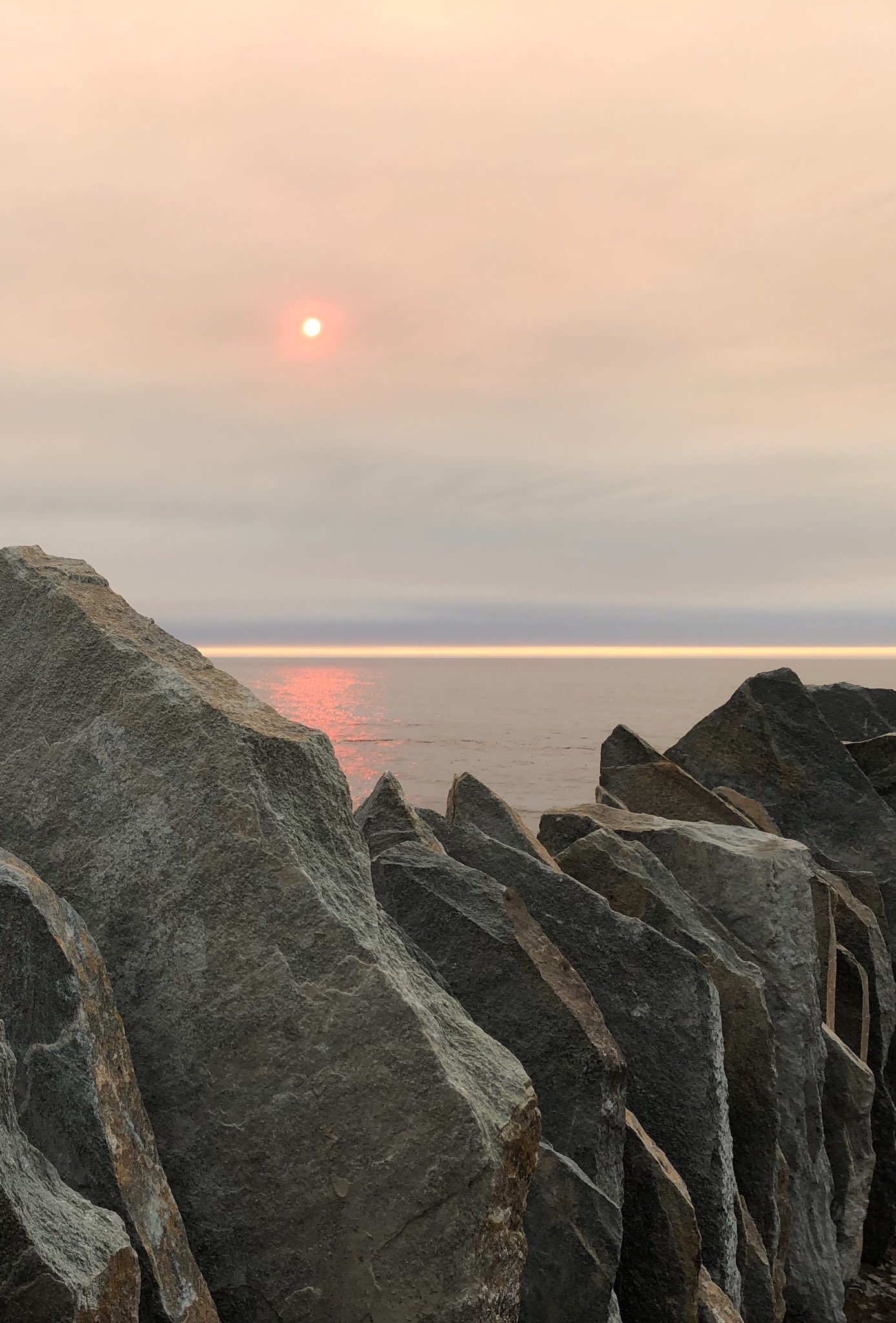
It began as a concept to replace the existing fence with something that would fit into the vernacular flavour of the local landscape and specifically make reference to the various idiomatic split rail fences seen along the Northern California coastline. Instead of using old growth hand split redwood, we used older growth mica schist hand split flagstone material from the Mojave desert. The four foot (plus)slabs are stood upright back to back along the entrance border of the Point Arena Lighthouse, looking out over the Pacific Ocean.

Their spacing, their verticality and irregular heights give the impression of wooden picket fencing from a distance, but as you approach closer, the fence structure begins to widen in appearance and looks more a thick jagged stone wall. The dynamic upright  surging of the cliff’s seen here on the point (and along the Mendocino coast) are a geological feature that the stone fence/wall is also designed to mimic. Shale boulders from Annapolis are spaced every ten feet to brace the upright slabs. The gate boulders and middle pier boulder are bordered with pebble motif compliments of Kevin Carman talented artist mason musician and poet working out of Art City in Ventura  Ca. The pebbles represent the crashing of the waves against the tall cliffs.

The wall/fence/installation uses no manufactured fasteners . Instead the stones are lodged together tightly using sandstone spacers notched into one side of every vertical mica schist slab. The spacers are wedged into the slabs along the same horizontal line so as to appear like a continuous fence rail when viewed directly from the side.


Twenty-four tons of material stretches more than 90 feet across the entrance to the lighthouse property. The backdrop of the lighthouse and vista of ocean shore provides an unparalleled setting for this totally new wall design. Tourists standing back to take photos now kneel down to include the ‘fence’ in the picture.

Tuesday, November 13, 2018

Buenos Notches


The upright slabs in this latest project required mucho notches to be cut in them in order to slot and wedge the stone spacers between them to produce the upright redwood picket fence look we were trying recreate in stone.


Thursday, November 8, 2018

The shadow knows

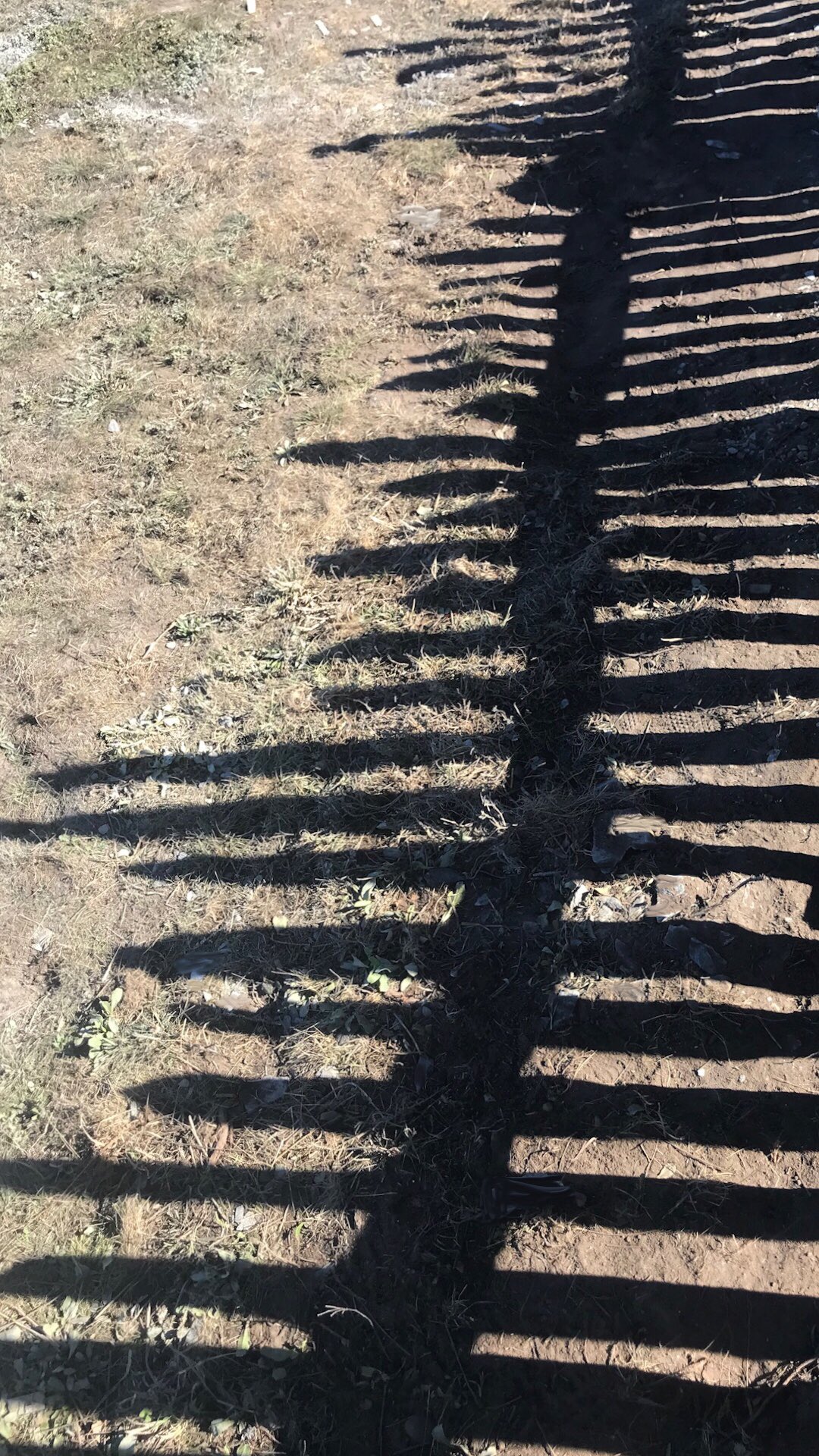
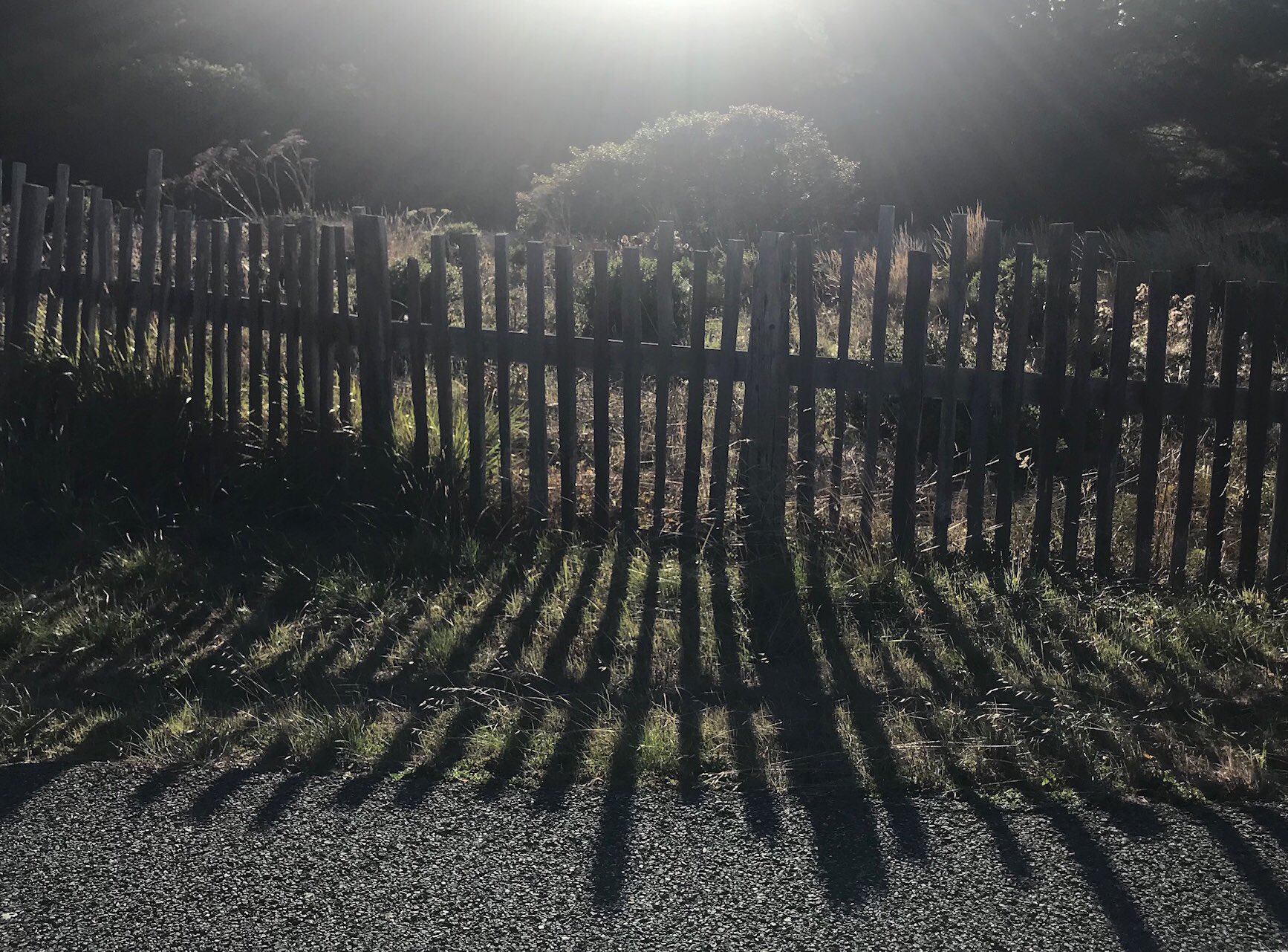
The familiar late afternoon shadow of a California redwood picket fence - or maybe it’s not. 

Wednesday, November 7, 2018

Tiny Hopes


It looked like he was going to jump, but he actually had to climb a tiny way up the tower to see if there was a glimmer of hope on the horizon.

Tuesday, November 6, 2018

Fencing along the coast


This redwood picket fence is being built by Kent Cochran of lighthousemusicians.com. He’s doing a great job. The posts as are the pickets (which are to be nailed on later) are all hand split with wedges. Our fence up the coastal road will have a similar look, but we’re not using wood.

Monday, November 5, 2018

New stone circle.


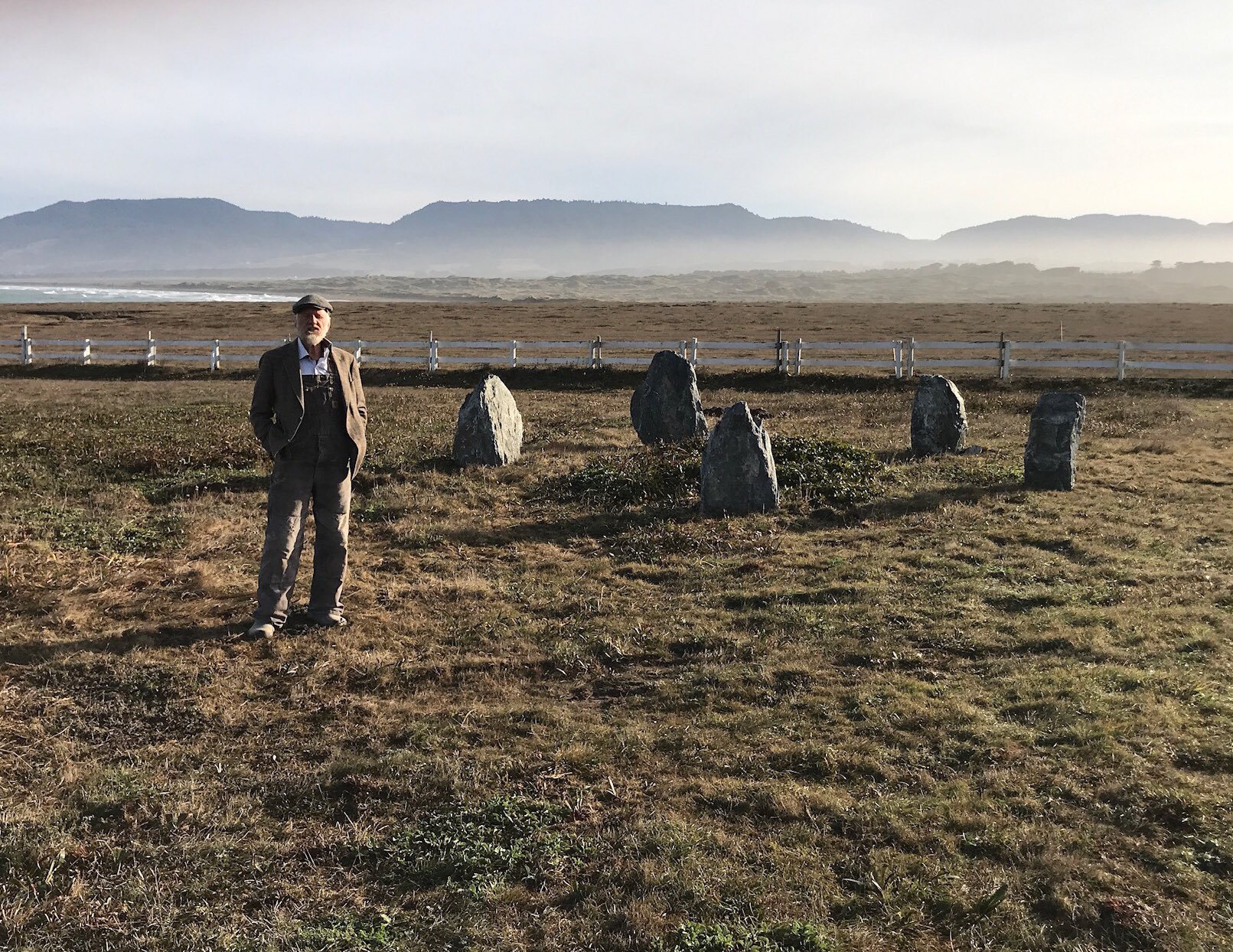
I helped plant a new standing stone circle on a well known point of land that juts out into the Pacific Ocean. The old one was there in our imagination, we just had to agree on a suitable site and then cultivate the soil and dig in the special 'henge' stones. And now all there is to do is wait. We anticipate they will grow to be quite tall within a few thousand years .

Saturday, November 3, 2018

The Daily Post


Our next stone project involves reinterpreting the redwood pickets seen along the Northern California Coast near Sea Ranch. These idiomatic containment fences capture the rustic individuality of rural Californian living. The pickets, along with the posts, create daily interest as we drive back and forth in the varieties of morning and sunset light. They offer moments of reflection too that are as illuminating as anything you might find in print . My read on it is - there’s likely a new creative opportunity to explore a geological connection . Stay tuned. 

Friday, November 2, 2018

Our inspiration.

Our inspiration, our ideals and our courage, come from the land, the soil, the rocks, the trees, each other. 
The flag can be anything.

Thursday, November 1, 2018

Holes in the walls

If you look long enough you will find them everywhere.
But will you find your way back.