Showing posts with label machinery. Show all posts

Wednesday, September 22, 2010

Weighing in on different ways to lift heavy stones.


In keeping with the 'Thinking With My Hands' theme, I can count on the fingers of one hand the number of methods we have used to lift heavy stones up onto a tall wall or dry stone structure .


1. The first and most primitive way of lifting involves wooden boards or poles system. You simply slide or flip large rocks up along strong boards onto the top of the wall. In the video above you will see how DSWAC members managed to lift a huge lintel stone into place, as we completed the last stages of the traditional Scottish Blackhouse, which was built during last year's 2009 'Rocktoberfest'.

We had a fork lift there which could have easily done the job, but we felt it was important to do it manually, partly because we had all the manpower there that we needed and partly because none of us wanted to use machinery unnecessarily when we were building an authentic dry stone structure trying to duplicate how they would have authentically built it in the past


2. The three pictures above demonstrate a second method, that of using pulleys. We used a simple pulley from a rent-all store for all the vault stone we lifted onto the Cabane roof at the three day 2008 'Rocktoberfest' held near Cobourg Ontario. It was quiet, efficient, good exercise and extremely satisfying to build the entire structure without relying on heavy machinery.


3. The third method of using hoists is useful if the stones you are lifting are very heavy. We set up a hoist to lift the large rung stones that connected dry stone towers of this unusual 'rubble helix' which we built during the Canadian 'Rocktoberfest' in Garden Hill Ontario in 2007. This structure was a very unusual shape and required scaffolding to suspend a beam with a hoist attached to it to pull the long flat heavy stones up near the middle of the paired ascending spiraling dry stone walls.
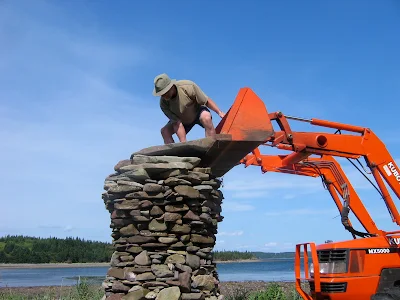


4. And of course there is the technique of going up along with the stones you are using. We have often had projects requiring that will we stand in the bucket of a front end loader tractor for example (filled with choice stones) in order to complete the top section of a tall structure. Here you see me finishing the Alban Beacon we built for Farley and Claire Mowat at their summer residence near St Peter's Nova Scotia in 2006.


5 Finally there is the method of having the stones moved up to your working area with a Caterpillar, Gradall or some other type of large excavator/boom tuck/rock-picker-upper type machine, as we did in Stone Symposium in Ventura, and at the Marenakos StoneFest held near Seattle recently.


Sunday, September 19, 2010

Handy Cap Stone


Graham Watt put a lot of time (nearly four days) and a lot of skilled handiwork into changing the shape of a huge square chunk of limestone into an impressive cone cap for the clochan that StoneFest participants built last week near Seattle Washington. Christopher Barclay another Canadian and several other Americans also put in hours of hand-chiseling on the large white block to coax a geometric curve domed shape out of the stone. The shape had to be the exact dimensions to make a final seamless transition from the dry laid contour of the rest of the hut up to the peek. And it it had to be finished on time to hoist it on to the beehive structure by Friday afternoon.

It was decided that the final surface of the cap stone should be detailed with the shapes of all the hands of those who were involved in this project. Dry stone wallers, carvers and sculptors in stone traced a profile of their hand on the dome and then they, or one of the letter carvers, carefully chiseled each hand print out. The large white limestone capstone ended up looking like everyone had put their hands into plaster of Paris before it set.


The huge stone was lifted on to the stone hut using a large Caterpillar with a massive mechanical claw, and with the help of many more hands it was eventually lowered into place. Professional sculptor John Fisher is seen here using one hand to guide the stone down onto its final landing spot on the top of the clochan. The 'handy' capstone proved not to be a handicap at all, in terms of finishing the race towards having this magnificent beehive hut project completed in time.

Thursday, September 16, 2010

Grasping the obvious.


Third day of the StoneFest at Marenakos. The sides to the beehive hut are steadily going up under the careful supervision of Patrick McAfee. The 8 large rectangular stones form the canted sides of four crude window openings. Also note the batter is starting to go in faster to form the signature curve of the Irish clochan.


It is interesting to compare the 'noise' level in this video compared to the previous posting where there are no machines running.

It always amazes me how dependent stonemasons have become on large machinery. This powerful mechanical 'hand' does the job of 8 men lifting these stones into place. Unfortunately there are those of us who didn't come here to watch heavy machinery move stones. Most of us see that every day in our working environment. What many of us came to see and experience was a transfer of knowledge, including a passing down of an inheritance of stone moving skills different to those used on every job site today.

Im just saying.