Wednesday, March 13, 2024

The time has come

 ..

_


The time has come 

The wallers said

To talk of different states,  

Of shale and schist, and surface cracks

And amethyst and slates

And why debris forms mountain scree

And why the earth has plates.


They spoke of sub-atomic mass

Of particles and strings,

Of quantum leaps and isotopes

And earth's magnetic rings.

And after that they took some stones 

And built some arty things .

Saturday, March 9, 2024

There is A story here


There is a story here. There are Many stories here. Some are made up . Some are partially true based on who’s telling the story. Some of the stories incorporate things imagined in our dreams.

We’ve been here before . We respond to the image and try to understand the story that is implied. The point is there are many stories here . There isn’t ‘THE Story‘. THE story is just A story. It could be a good one or a bad one, a clever one or a crazy one, a new one or an old one. It is just another story .

Saturday, March 2, 2024

Rocks of Ages


A rock, when it gets employed in a dry laid wall, becomes a 'stone'. It now has a  job. An employed stone can be any colour, shape, type of material or religious persuasion, and more importantly it can be any...any age.


The newer aged stones, ( usually taken from a freshly quarried source) we like to call toddlers.

Yes, it may seem wrong to put young toddler rocks to work, but then they really are already, millions of years old!  The geological material they have broken off from has had plenty of time to form . It's just that having been recently extracted from the bedrock, they've not had a lot of exposure to the elements yet, so their 'character' has not really had time to develop.


In a wall they may look too new, too uninteresting, or worse, too brash or too sure of themselves. Their sharp, freshly hewn faces don't possess that patient beauty and calm humility that only comes with time. 


After a while, at a certain age, newly quarried  material changes from young 'ado-lesstones' through puberty to full grown adults. They begin to have character. 


As they pass from the awkward ages, they maybe start to grow lichen or moss and develop interesting textures. In a wall they will all start to have what is called a 'patina'.

It will take time, but the pre'Patin-Agers' will eventually become as experienced, and look as aesthetically attractive as their wizened elders.

Wednesday, February 28, 2024

What happened here?


What happened here? Why did this stone monument fall apart? Did they skimp on concrete footings ? Did they not compact the soil before they started building? Maybe they should have built it in a better place, with better drainage? Maybe it was just built badly?  

Now if they’d just engineered it a bit better, you know, like made the sarsens bigger, fatter, maybe the thing wouldn’t have fallen down so soon? 


Tuesday, February 27, 2024

Rocks really know how to stay in shape


 We can learn a lot from stones and rocks. They're hard, working. They are infinitely patient. You know where you stand with a them. They're friendly and easy going and if they don't like you they'll never tell you. Of course they might pinch you, or smash your foot, but generally they are not the first to start a confrontation.

We don't really know how hard stones have to be on themselves to stay in shape. Most of the time we only observe them relaxing doing nothing. But on occasion you might find one getting good on the freeze/thaw cycle. If they didn't, they'd be useless in a dry stone wall. 

If they were the friable type ( all crumbly looking ) they will sweat a lot and in cold weather, they will start to fall apart. Thats why stones that haven't passed the freeze/thaw exercise program, will never be chosen for a job in a wall.

By the way that's how you can tell the difference between a stone and a rock. A rock is an unemployed stone.


Monday, February 26, 2024

Synchronicity and Serendipity


This video was created by Karina Sinclair for Landscape Ontario Trade magazine. I am thankful that some of the questions Carina asked me, allowed an opportunity to probe a little deeper into what dry stone walling (particularly faux ruins, fictional dwellings and landscape follies) is all about. 

In the next few posts on Thinking With My Hands I hope to explore the connection between Synchronicity and Serendipity further.

Sunday, February 25, 2024

Stonescaping


I encourage StonEscaping


Stones escaping from their enemy : concrete products

Escaping from metal bars , rebar, tie pins, fixatives, adhesives, and threaded bolts. 

Escaping from the machinery, the manufacturing the crushing burning, moulding, cookie-cutter, mechanized, landscraping industry 

Escaping from the mad toxic bland manmade world of fabricated (so called) natural products


Escaping from the advancing army of bull dozers

Escaping from being dumped in holes and buried under the ground 

Escaping being imprisoned in cement and concrete 

Escaping from being plonked, abandoned, in meaningless artless clumps in public places 

Escaping from being lined up at borders, from their parking-lot-in-life non-curb appeal fate . 


Escaping to the freedom of a dry laid wall. Where all the parts are connected, yet free to move . 

Escaping from the saw. The grinder. Escaping from the jaws of mass production, over engineering, monoculture, unimaginative, repetitive, mass produced carbon-emitting copies of real stone...... 

to become beautiful liberated stones in 'Walls Without Mortar' 

Wednesday, February 21, 2024

Where do you get your straw from?


A waller often has to do magic with the material he finds himself having to work with. It’s like spinning gold out of straw.  It seems impossible, and yet the "straw" is somehow slowly magically transformed into a work of solid gold . It happens so often. But I wonder do magicians ever fuss over what kind of special hats they are going to need to pull rabbits from, or might an Imp like Rumplestiltskin ever complain about the poor quality of moldy straw he’s expected to attempt to spin into gold, No I think that if you doing sorcery, its not at all dependent on having special grade material to begin with.


Yes there are different grades of straw But I assume it doesn’t make a difference what kind of straw you use, if magic is going to be applied to it, anyway. Isn’t it all of the same order of magic-natude ? And so what do you say to someone who comes along later and sees the solid magic you've created, and (as if it makes a difference) asks “Where do you get your straw from ?


Tuesday, February 20, 2024

Mortar Without Stones


When I used to do mortar masonry back in the 80's , we had a helper Eric who mixed all our mortar, wheel barrows of it. When we'd finish a chimney or a stone addition, and took away all the scaffolding, we'd often stand back and admire the stonework. I'd say something like "Look at all that beautiful stonework". He'd stand there for a while and then say "Look at all that beautiful mortar"

Monday, February 19, 2024

No Entry


I saw this when I was bicycling through Menton, France last month. Could they have walled this entrance in better so that they didn't need the No Entry sign too? It looks like it would stop a tank, but maybe someone thought it still looked a little under-engineered. 

Sunday, February 18, 2024

The Picturesque


John Ruskin, on the necessity of properly anticipating the picturesque ruined look that comes only with time

"In architecture, the superinduced and accidental beauty is most commonly inconsistent with the preservation of original character, and the picturesque is therefore sought in ruin, and supposed to consist in decay. Whereas, even when so sought, it consists in the mere sublimity of the rents, or fractures, or stains, or vegetation, which assimilate the architecture with the work of Nature, and bestow upon it those circumstances of colour and form which are universally beloved by the eye of man. 

So far as this is done, to the extinction of the true characters of the architecture, it is 'picturesque', and the artist who looks to the stem of the ivy instead of the shaft of the pillar, is carrying out in more daring freedom the debased sculptor's choice of the hair instead of the countenance. But so far as it can be rendered consistent with the inherent character, the picturesque or extraneous sublimity of architecture has just this of nobler function in it than that of any other object whatsoever, that it is an exponent of age, of that in which, as has been said, the greatest glory of the building consists; and, therefore, the external signs of this glory, having power and purpose greater than any belonging to their mere sensible beauty, may be considered as taking rank among pure and essential characters; so essential to my mind, that I think a building cannot be considered as in its prime until four or five centuries have passed over it; and that the entire choice and arrangement of its details should have reference to their appearance after that period, so that none should be admitted which would suffer material injury either by the weather-staining, or the mechanical degradation which the lapse of such a period would necessitate.

Seven Lamps of Architecture


Saturday, February 17, 2024

Discovering the Borie Story.


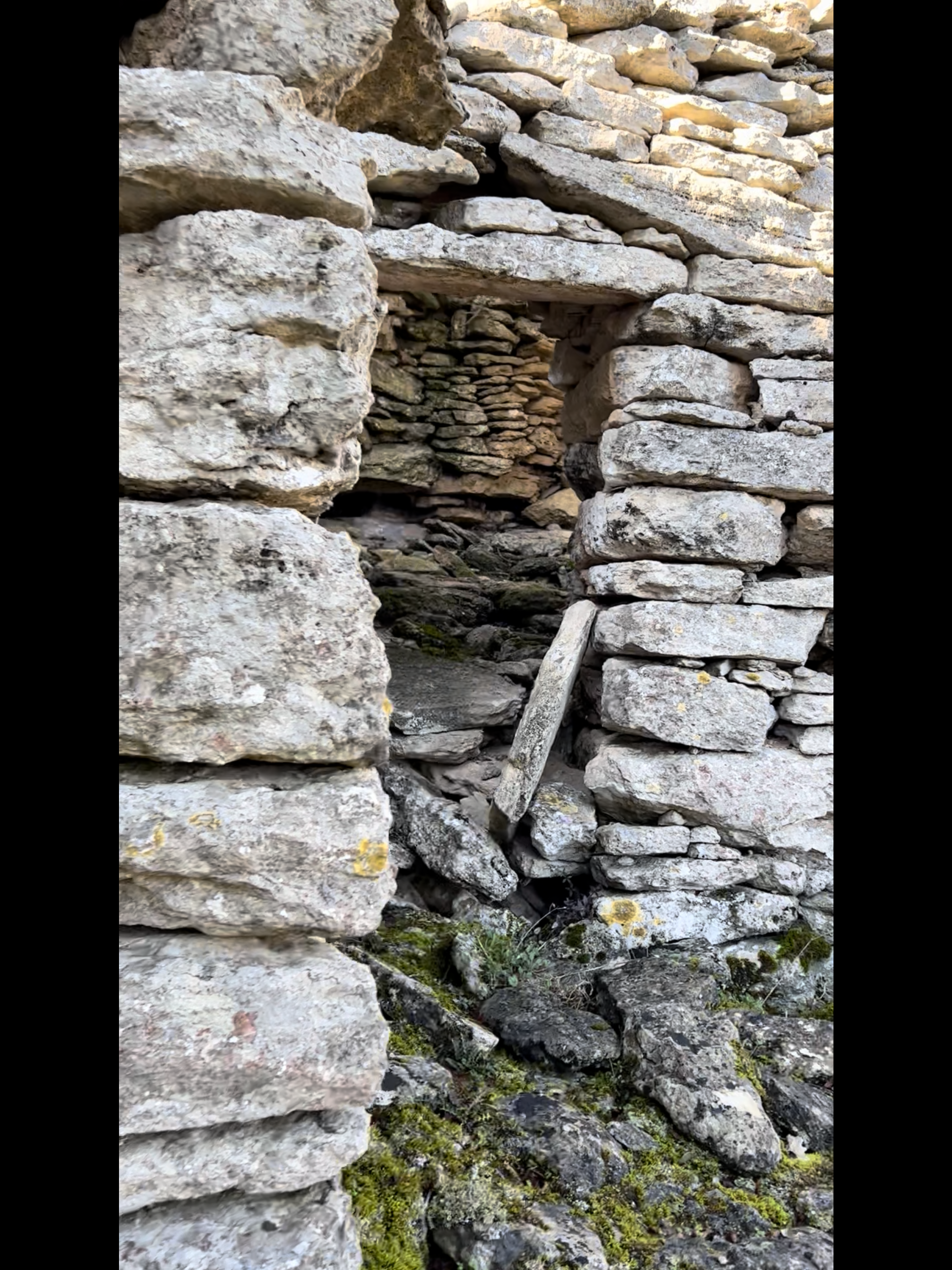
In the vicinity of the Village of the Bories at Gordes in Vaucluse, France we looked amidst the bushes for other unique structures. We found one that had not been restored to someone else’s concept of what it should or could have looked like .  


Everyone has an interpretation of the original. But we wanted to see a site (inside and out) before it was all fixed up. We wanted to learn its story. Its good to be able to study deterioration that has not yet been repaired, to see for ourselves things like, how and why a section of wall failed, or how a strange shaped opening fell apart or why a thin lintel in the side opening hadn't cracked. 


We learn more from seeing the mistakes of the original builder than the repairs of those who follow . 


And are they all mistakes?, Really?  OR, Were they the best answer for the circumstance, for the purpose perceived at the time. What was the time period the structure was determined to likely be of use. 


It's difficult to surmise what happened if the evidence has been removed. 


Questions like -

“Were there any long through stones or did they all break? Or did someone steal them?”


“Why is this door opening so short  ?" (unlike all the ones in the Village of Bories , that had been rebuilt a foot taller)


We enjoy sandcastles, not just seing them in their pristine state, but to delight in watching the sped-up processes of 'decay over time' – to watch how an arch collapses, or where incoming water erodes away the wall, first. We gradually learn to appreciate the inevitability of impermanence. 


To every thing there is a season, and then, that season is over. We want to watch the seasons change. We want to take pleasure in that gradual eventuality.


It seems foolishness not to accept or take any pleasure in or at least be curious in that 'eventuality'. After all it is an essential component of existence, – the propensity of all things to move towards their expiry date.


We shall continue to build things to last, yes, but never suppose we can, or indeed think we can defy, or ever win over the forces of entropy.


A modern ( over engineered ?)  building often makes, no concessions to the reality of beautiful decay. 


Vernacular rustic humble aged structures seem better, more beautiful, for accepting their lot in the process of time. 


Whether it is a humble dry stone hut, or a proud Roman aqueduct, the reality of its journey towards obsolescence need not be disguised.


We all start as adolescents and THEN ... we become obsolescent. The 'then' can be a long beautiful journey.


Friday, February 16, 2024

Doing Permanent Damage


 I have always maintained that building a dry stone wall doesn't have to be a trade-off between beauty and sturdiness, and that both can be accomplished using even a random assortment of stones. It is possible to erect something that is built like a tank, but is a tank really beautiful. A wall, unless it is built in a war zone, doesn't have to look like a tank-barrier either, just the same way a house surely doesn't have to look like a bunker.


Like good art and much of life, restraint is the key. War is about excess. A wall built without restraint is a wall that wastes too many of the better sized and squarer flatter shaped stones. Such a wall demands that more and more 'recruits' come in and lay down their lives for the 'wall cause', which doesn't so much 'raise the standard' as raise the cost . 

"But" you say to yourself, "why spare any expense?" 

I suppose such a walling effort will appear to be a kind of heroic 'war effort'. If you are not in love with what you are doing, then your wall can be excessively blocky and dull, and you can call for throughstones to be inserted every other foot and use fairly unchallenging stones everywhere. It is no longer about being ecological or being frugal with what you have or even being creative, but it's about militarily 'securing' your position and establishing your dominance over a section of wall, even if it requires using a lot of pre-cut stuff from the pallet and anything else you secretly know is pretty hard to come by .

Yours becomes a pragmatic wall, the antithesis of art. You can pretend it is the 'Wall to End All Walls'. You can assure yourself that you haven't skimped on anything in a slavish commitment to permanence. But there is an obvious point where the beauty and spontaneity are lost. A wall like that might win the battle for lasting the longest or the prize for looking like you couldn't push it over with a tank, but it won't necessarily be is a 'handsome' wall, and in the end, ironically, it wont be a wall you will want to remember..

Thursday, February 15, 2024

Over Blown


It may be difficult to describe the actual point where a project begins to exceed the well-founded structural (or design) requirements, but most of us recognize full blown overengineering when we see it.  ( obviously if we're talking about the modern gas powered leaf blower, then the quantum leap it makes from what was the perfectly good job that a rake can do, is quite obvious.

And yes, the answer to the question is – A dry stone wall can be over engineered.  

Such a structure can be ridiculously too thick, have unnecessarily tight fitting faces, have too many through stones, (or ones too over-sized) or that have all the stones sawn and/or completely fabricated and divested of their inherent character. The end result of over engineering is that the thing has an annoying overworked appearance, or worse, looks like someone was just trying to show off.

The next question is why does this happen. Why can something as simple and as time honoured a craft as dry stone walling still slip into that trap of becoming overengineered? Why is it not obvious that instead of being a logical, frugal, and uncomplicated way of building, it often compels those who practice the craft to outdo or overdo or overshoot what is needed or what has been done before?


Wednesday, February 14, 2024

What is the point du gard?


In the next couple of Thinking With My Hands entries I'd like to investigate the meaning of the question..."Can a dry stone wall be over engineered ?"


See you tomorrow


Tuesday, February 13, 2024

What do you connect with


All of us

Are looking 

To find a way of connecting.

We learn the principles of connection sometimes 

By experimenting putting things together.

Connecting them like stones in a wall

And we learn 

What works

And what doesn't.

And we make the connections.

And our wall takes on a pleasing form if is built right 

And reveals the beauty of connectivity.

And fittingly,

we and others 'connect' with what we see. 


Monday, February 12, 2024

Bucket List


We saw a lot of the things in France we wanted to see on our first Saturday off. Six of us crammed into the van and went off to explore The Pont du Gard and several dry stone Bories and Cabanes along the way. Everything was going well until the sliding door on the large van that Mark had rented got knocked off !  (Don't ask how)

After the initial shock and the resulting despair, we contemplated a grim scenario of us driving around the rest of the month without a door.  


We did manage to eventually get the door back on enough to continue our travels ( Sean Adcock used a rock as a hammer to smash the van latch back into position, and the duck tape I bought came in handy for sealing the iffy door partially shut)  

After that day's adventure,  our van was renamed The Bucket List,  since we knocked off several interesting things on that drive .


Sunday, February 11, 2024

The Fresh Impressionists


 Nous Laissons Une Impression Durable

We don't just do it for the Monet. 


Monsieur Mark Ricard, 
Project Manager, @drystoneart, Marculeus

The man who made sure we made, not just dry stone art, but more importantly, a durable impression on the French landscape.