Thursday, February 10, 2011

Fresh from the quarry to your garden.


While the quarry at Sydney Peak is about as 'green' a quarry you can imagine (in California this is very important), it occurred to me that it is also very much a growing operation - growing not just in size and output, but in the way they access the stone material too. It's as if they are growing the stone. On my visit to the quarry this week I was taken by how similar some of the extracting and preparation operations were to farming and processing food, and how some aspects even looked the same.

As we walked into one section of the quarry, there were a dozen or so workers bent over picking the product the way you might see fruit or vegetables being picked in a field. It was being gathered and sorted and after being put onto metal crates it was then carried off by machinery in the same way you might see a large farm operation run.

The stones that the labourers were picking were literally popping out of the ground because the land had first been 'plowed' by one of these heavy pieces of equipment.

The huge cat goes back and forth over the same couple of acre quarry plots with the big prongs at the rear ripping up whole new layers of chunky bedrock for extracting. After all the stones are picked, the plow goes over it again.

Next, in the same way food is 'processed' so too, after being picked, a lot of the the quarried stone goes though a process too .

The stone processing plant

Specially cut stone packed in wooden crates and ready for market.

Here in the Sydney Peek plant the material can be cut and trimmed, sanded and/or polished and made into more refined products and specialty items. In some quarries the cut stone is flamed to give the sawn edges a rough natural look. After it is graded, it's carefully packaged and often, as with food, it's even shrink wrapped.
A piece of highly polished 'archalyte'
from a shrink wrapped crate of processed stone

The final product is shipped to market where consumers like you and I come to choose from a selection of the 'fresh cut' produce (or maybe some processed stone, but never the synthetic, artificial stuff ) and then we take it home and cook up some wonderful things with it.

Tomorrow let's look at what we might consider filling our 'pallets' with, and see what special stone dishes (served on stoneware perhaps?) a stone lover might come up with.

Wednesday, February 9, 2011

Pointing and Peaking


Yesterday we took a field trip out to the Mojave desert to Ridgecrest California. They tell me this area is called the 'high desert' as apposed to a low desert, an example being the Colorado Desert, which confusingly is actually in California as well. The Edwards Air force Base is located here too. Some of you may remember the 'stuff' about Chuck Yeager breaking the sound barrier over 60 years ago and the stories of the early US astronaut program there, 'right' ? Anyway at about 6 in the morning we were flying past the base on our way to visit Sydney Point Quarry. It was still dark and the desert looked like Manitoba at night.

When we arrived there T.J. the manager, kindly showed us around the quarry. Here he is pointing at the actual Sydney Point Mountain which Blakes Quarry is named after, but that's another story. For anyone interested in learning more, their website is www.sydneypeak.com

Anyway the quarry is a very busy operation, running at its peak, you could say, employing over 40 people. On their brochure and on their website they proudly state - At Sydney Peak Stone we are striving to become California's first green quarry, adhering to the most recent changes in California's State Law. Natural Stone is 100% usable, can be recycled and emits no volatile organic compounds.

They have lots and lots of quartzite schist material. It's very durable, nice looking, splits like a dream and comes in a good number of thicknesses. Its not like the soapy flaky stuff that you sometimes get from other stone suppliers. As with most schist however it is very hard to chisel across the grain. You pretty much have to find their natural faces rather than try to make a face.

TJ is really into 'production stone' making cut cobbles and stone bricks and veneers of various styles, all of which are geared for various architectural residential and commercial applications

We were looking more at what kind of dry stone wall material was available. They sell pallets of really nice 2 and 2 1/2 inch 'copes' as they call it, which is an excellent material to use in a dry laid application in a wall or garden feature.


Here is another look at that gable wall incorporating a lot of the Sydney Peak cope for the diagonals. They usually sell this size and shape stone for using as flags in patios and the tops of walls, but it's great for building an entire wall. Unlike a patio or cope, the side face of the stone not the flat surface, is all you see in the wall, of course.

Tomorrow I will post pics of what goes on at the quarry and explore some similarities I was intrigued to discover between stone quarrying and farming.

Tuesday, February 8, 2011

Keep your hands on the wheel.


Here in this part of California there are numerous winding roads that go through a lot of rock-cuts and along side of steep cliffs. It can be very dangerous because cars often run into rocks that have slid down the side of a mountain or cliff and do quite a bit of damage. Thankfully there are now special activity parks and new recreational apparatus being put up near many of these hazardous spots so that the rocks can still have fun but not get hurt.


Monday, February 7, 2011

Leader of the Packers.


Being someone who builds walls without mortar and knows very little about football it's understandable that while here in the states I would have to take up cheering for the Packers during yesterday's Super Bowl. The 'green' team symbolized all the good things about dry stone walls and the activity of walling in general, yes even with with all its thrills and spills.

Just think of all the similarities and all the packing that goes on. The team packed the stands with their fans. Every play was packed with excitement. It was an action packed game right to the end. And Green Bay packed a punch to send the other team home packing.

Walling too is all about packing. The clever decisions, the deft movement of the hands and body, the placement of the rocks, all of these activities are directed to doing a good job of packing. You can't be fumbling around. You can't afford to miss your 'field goal', to complete the yardage and still put up a good defense. All of this involves a great amount of skill and perseverance even just for a couple of yards.

The packers of this world scored a victory yesterday. They didn't leave any wiggle room for doubt or indecision. They didn't leave space for things to collapse and fall apart. They did the job relying on the strength of their own bodies without giving in to an opposition representing 'Steel' and hollow technology. We packers are celebrating their win and all feeling like the 'leaders of the pack'.

As a bit of a footnote; the team was first known as the Indians, but soon became the Green Bay Packers, after the meat-packing company which put up money for uniforms and equipment in the team's first couple of years.

I'm still thinking packing meat can't be very different from packing stones either?

But maybe that's another blog.

Saturday, February 5, 2011

Looking out at the right angles


Yesterday's posting involved thinking about the propensity for certain granite to accommodate being shaped at right angles. I began to notice throughout that same day many more cube-like and rectangle chunks of all different sizes in the vertical formations laying around the countryside. The mountains are green this time of year making the grey rocks appear quite prominent and abundant.

There is so much of this tending-to-squarish upright rock dotting the distant hills along the steep slopes of the canyon, that after a while I began to imagine it wasn't random stone at all but a vast settlement of narrow stone dwellings and hewn standing stones. The rocks off in the distance gave the impression of some ancient civilization of rustic masons, scattered across the hill sides all dwelling in narrow stone huts they had made. They had built everywhere on the hillside with the rocks that were right at their doorstep, and thus changed the look of the entire landscape from a vista giving an impression of randomness to an ordered array of squared structures.


The video above is a short clip of the long trip back at the end of a day in the mountains. There was over 40 minutes of the trip which involved traveling a narrow crazy winding river road. A lot of the canyon was even steeper than this.

Apparently the Kern River Canyon was created primarily as a result of tectonic forces, and not as might have been expected, by the erosional force of the river. The view off to my right hand side was amazing to behold, if only for the sheer volume of beautiful stones we saw along the way. I feel an even greater affinity with this material jutting out of the hills, I have discovered it is not just agreeable looking but also an accommodatingly shapable stone. As we drove back I appreciated this myriad of stone material perched far above us, from having hugged and moved and shaped smaller specimens of it all day higher up the canyon.

Friday, February 4, 2011

Looking at the right angles. Part one.


You can't see it very well in this photo, but this random chunk of granite just about to be shaped already has a natural ninety degree plane appearing and has indications on its surfaces that it would be easy to break at right angles both to the bedding plane and the face plane. This seems to be the tendancy for much of this beautiful salt and pepper granite found along the Kern River Canyon and all around Lake Isabella in California. It is an amazing workable rock to use especially for squaring up corner stones. It is much different from the rubbery sandstone, the hard basalt and the flaky mica schist available out west, all which is difficult to split or pitch to even get a good face.

As you can see in the above shots, the rock was easily chiseled along the rest of the natural 'ninety' that had already 'showed up' in the stone.


Thursday, February 3, 2011

Do Rocks Move?


Stones are the most moving things on earth. People of all ages have been moved by them, as they are not only heavier than most other things, they also hold themselves together 'faster', and other things under them 'more fast' than any other naturally occurring material on earth. It could be said that they are traveling through existence at something way heavier than the feeling of, or speed of, light ( lightness ).

Because of their great internal 'wait' (weight X negative velocity) they create these unique three-dimensional extremely dense gravitational fields which look more like what you and I would describe as rocks, but are really stationary fragments of invisible geological force fields.

Since they have such a timeless inherent inertia ( invisible self-contained inner movement ) they have often been perceived as merely motionless and inanimate but this is not the case. They rock ! They roll. When their faults are exposed they make faces, They lie down in bedding planes, and 'split' along certain lines and shift, fall, slide and drop whenever they get a chance, just to mention a few examples. If you've ever carefully studied a rock on one, you will know they travel around quite a bit on a 'freeze thaw cycle'.
'Rock on a freeze thaw cycle'
It may not seem like its moving, but it is.

Tuesday, February 1, 2011

Hand Waves and Hand Dollars


Katsushika Hokusai

The Pacific ocean was very choppy yesterday. The waves, all random sizes and shapes, were breaking far out at sea and every crest was being violently pushed back by a strong off shore wind. Tufts of foam and spray scalloped off the top, the surging spray being thrown backwards as if there was some water tossing celebration going on. The curling fingers of the waves that did manage to arc forwards (shore-wards?) looked like the ones in the wood block prints by Japanese artist Hokusai of stylized bubbles and spray reduced to fractal-type patterns.

This condition was evidently not surfing weather. Usually there are at least one or two of them in the water, near where I am staying on the Great Highway, trying to catch a wave. Yesterday the waves were not cooperating. They were like misty ghostly hands, waving mockingly. They didn't want to be caught.

Funnily enough you couldn't feel any breeze. The prevailing wind must have been vaulting right over the sandy embankment behind us and heading off to fight the oncoming surf. The waves that managed to reach the beach were foam-lined, exhausted yet still sizzling.

We, excited to be at the ocean for a second time on our trip to northern California, did the goofy sandpiper thing - venturing as far into the ocean as we could without getting our feet wet, and then scurrying back with each anticipated advancement of the briny sea. The waves spread over the shiny beach in foamy layers, like tussled sheets hurriedly being drawn up over a sandy bed on the last day of a seaside vacation.

The soggy beach, now at low tide, was strewn with sand dollars. Hundreds of them, in every state ranging from impressive mint condition samples to the most fragmented specimens not worth putting back into circulation, lay drawing little attention from the regulars walking along the beach. The distinctive sand dollar shell pattern, a kind of melted mix of Maple/ Marajuana leaf design on the top of the shell, seemed remarkably contrived.

The dollar had obviously taken a hit and was down that day. It had lost its value except to us dazzled Canadians, who found the white shelled larger sea-version of our Loony a fascinating commodity to deal with on our walk along the California coast.

I had an idea to take this 'finan-shell' jackpot in hand and try to arrange them all in a dotted sand dollar pattern on the beach. Probably not an original idea, but still worth doing, as one's own tiny response to the indescribable impact that both the ocean and the myriad of artifacts clinging to its coastal perimeters, has on those who come from landlocked parts of the country.

Several attempts at 'painting' with the shells were immediately erased by the advancing tide. Our dollar collection kept being dispersed into a swirl of liquid assets.


For a brief moment however, a complete design materialized and I had time to get this photo.

Monday, January 31, 2011

Push button landscapes


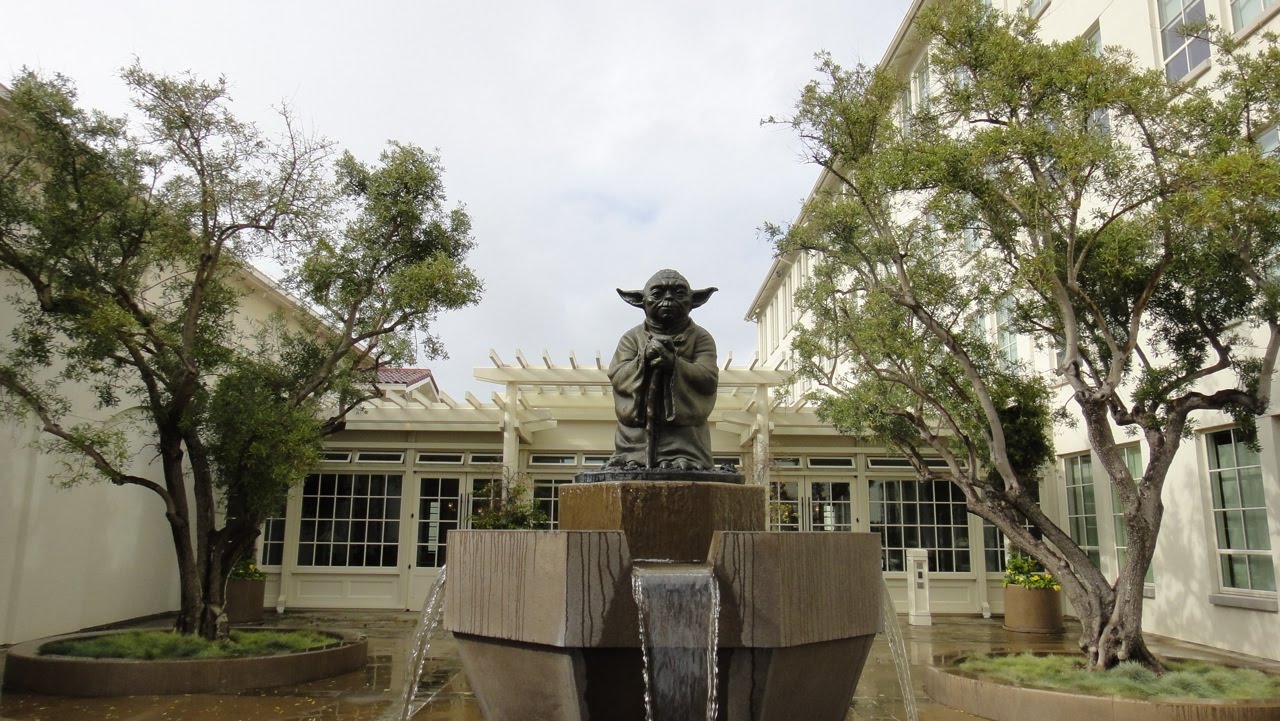
There is a manmade creek in the park at the Letterman Digital Arts Centre in San Francisco. Located in the Presido, this park is the setting for a stylish complex of buildings and the new home of three very successful corporations, Industrial Light & Music, lucas Arts and Lucas Films. The park was designed by well known San Francisco landscape architect Lawrence Halprin. Amongst other elements the park incorporates a clever selection of tree and shrub plantings, several bronze sculptures, and a 'life size' (can you say that about an imaginary character?) fountain/statue of Yoda.

I was impressed to also see some very bold uses of natural stone there, including a couple of curved (albeit mortared) walls and this very natural looking stoney creek bed. It not only looks like a un-engineered watercourse, it sounds like one too. However, the rocks that the gallons and gallons of gurgling water cascade over, through and around, have all been hand picked, carefully transported, arduously moved into position and then fixed in place (with steel and concrete) in order to give the impression of a natural flowing mountain stream. Everything was designed and redesigned to maximize the 'feel' of a real stream.


It is very convincing stone and water display, except of course for the emergency 'turn off the creek' switch located near where the creek disappears into the ground.

While I applaud the clever use of imported stone and pumped water to simulate a very charming little creek, I am thankful to have had the opportunity last October back in Canada to integrate some less expensive, local random stone material over a really free-flowing watercourse in the form of a traditional-looking Scottish dry stone bridge, at The Canadian Rocktoberfest in Landon Bay Park.


A collaboration of wallers spent a rainy week before the festival carefully building the bridge foundations into the bedrock, while the creek level kept rising.

We never did mange to find the 'off switch'.

Sunday, January 30, 2011

The Rockfish


Thankful for a Good Hand.


Thinking with my hands doesn't get much better than this.

I am just thankful to have associates whose hands think the same way mine do.


It is like having four-of-kind in poker.

Saturday, January 29, 2011

Under the influence of stones.


This is your brain on stones.

People call a certain euphoric state – "getting stoned", but if it doesn't involve actually working and/or playing with stones, I think it's just a chemical substitute! Maybe the reason we don't need any kind of substitute is because we have the real thing?

The human brain doesn't look much different than this potholed lump of ocean-tumbled sandstone we found on the beach yesterday. I wonder if their chemical compositions are that much different? Probably they have all the same elements whizzing around with a few of the atoms just rearranged a bit.

I was interested to discover that the leading pioneer of psychology Carl Jung, someone so steeped in the study of the mind and human behavior, maintained a continuing 'hands-on' interest in this mysterious connection between stones and human creativity?

This is what journalist, author and BBC broadcaster Mark Lawson says about the Jung.

"Carl Jung had a drive to transmute psychic images into form and substance . It was the force behind Jung’s tower building impulse in Bollingen. Through it he participated in an ancient and archetypal urge to secure the ineffable in the permanence of stone. History is filled with the archaeology of such longing, from the Paleolithic Venus of Willendorf, the stone circles of Northern Ireland, Stonehenge, and the monumental heads of Easter Island. At the center of Islam is the black stone, set in the wall of the Ka’ba at Mecca. All holy places and shrines share this human urge to meld meaning into rock so that it may endure for generations.

With each structural decision at Bollingen, Jung sculpted psyche into stone. As each stone was set, his resolve to define his own views was strengthened. Much as a castle’s tower claims its territory, Bollingen marked Jung’s emancipation from the Freudian dogma, laying stake to the ground of his own ideas: Throughout his life, whenever he got stuck, Jung “ hewed stone.” (Jung, 1963, p. 169) Stonemasonry was his therapy. After his wife’s death in 1955 he wrote, “the close of her life, the end, wrenched me violently out of myself. It cost me a great deal to regain my footing, and contact with stone helped me.”

Carl Jung working with and thinking about stone.


Friday, January 28, 2011

Pondering

They say a good waller picks up a stone once and then puts in the wall. To keep picking it up and putting it down again isn't efficient. Upon reflection, this seems to make sense. Each time you pick up the same rock you're expending a greater effort and building a bigger imaginary wall than the one you finally end up with. The accumulative effect of the stones, as they are moved and removed, and fitted and refitted, not only slows you down it weighs you down.

A stone weighs less underwater. It weighs even less when it's reflected upside down in water. The upper wall is the mirror image of the real one below. Or is it? In fact it has one more stone in it than the real one. That stone which looks like it has already been fit in the upper imaginary 'watery' wall is in fact still several feet away from being put into the lower 'dry' wall.

Perhaps building could be sped up if we paused and considered our pool of stones a bit more and pondered the shapes and sizes a bit longer. Building beside water, we may not always be able to step back to look, but we should still step back in our mind and try to imagine how our wall is coming together. A wall could be finished in half the time if we reflected on these sort of things.

Thursday, January 27, 2011

Walls Without Mordant Amalgamation


Found this interesting video trailer last night. There are many others like it on Youtube.

It makes building stone walls without mortar seem friendly, practicable, inclusionary, creative, exciting and fun.

Contrary to how a certain few 'professionals' behave, and what they might try to have you believe – walling often is all of those things !


A friendly bunch of students, instructors, wallers and onlookers
assembled at the nearly completed 2011 Stone Symposium dry
stone wall workshop held in Ventura California, early in January.

Wednesday, January 26, 2011

Pointing to my Brew.

There are not many American beers I like. So many of them seem tasteless and watery, way too weak . Either that, or they go overboard celebrating 'hoppy hour'. I prefer a beer that doesn't have a grapefruit peel aftertaste. Tried this one because of the name. What are the chances? It's brewed out of Fort Bragg, quite near to where we are. It's got a nice un-hoppy flavour. It goes good with stone chips, rock dust and rosy lingering California sunsets. I know the world is full of all kinds of pain and injustice, but is it so wrong to just be thankful to be alive and at the end of the day enjoy a little bit of un-hoppyness?


Tuesday, January 25, 2011

Not So Handy Andy.


http://thereifixedit.failblog.org/2010/10/15/white-trash-repairs-earth-4-5-billion-years-old-and-still-damp/


Not So Handy Andy has an interesting blog website. This piece is an installation by Uysal Mehmet Ali at the Land art exhibition in Chaudfontaine, Belgium

It seems to be an out of place posting in a blog devoted to funny red-neck quick fixes. The clothes peg appears to be a more profound statement. It leaves you thinking about things like scale and the relationship between man's use of trees and the resources of the earth. It makes me think about how hills and mountains are really formed. And about the fact that we've hung the planet up to dry.

It also reminds me of an image below sent to me last year.


I think my hands are getting eager to do something in stone along a similar (clothes) line.

Monday, January 24, 2011

NOT thinking with your hands


Sometimes yes, we wallers do use hammers and chisels, and then sometimes (thankfully, rarely) bad things happen to good wallers.

It's the price you pay as you're...

pounding along the 'inflammation highway'.

It's known as...

The ring of fire.

The bruise peninsula

All's swell that ends welt

A lesion to you

A 'lump' hammer.

A welcome to the 'whack-it' club

Graze Anatomy


Sunday, January 23, 2011

Another Slant On Things

Sean Adcock likes the steepness of his part of our wall. It rises at a cute angle. Yesterday the stone placement was hard to catch on to. It was so difficult to do that Sean and I thought we were slipping as wallers. It was such an uphill battle. Today the degree of our skill level has increased. The angle is still kind of challenging but so far neither we or our stones seem to be slipping. Sean sits down at the end of a good day and gives his 'ascent' to being photographed.