Thursday, January 8, 2015

Well Lit Sign On A Snowy Hill


Last Tuesday, on one of the coldest nights of the year, I drove by the looming dry stone sign that Eric Landman and friends built two years ago for his town. This commanding entrance gate to Grand Valley Ontario is situated on a prominent hill as you approach the town from the west and it is stunningly lit !


Andre, Evan, Akira and I were shown this wall feature not long after Eric completed it. Congrats to Eric (and his crew Ryan Stananought and Sean Donnelly) and to Whispering Pines.


Wednesday, January 7, 2015

Plantings make the stonework come alive

Thanks to Shelagh Lippay for her flora renderings of the garden wall we built, the photo of which I posted last Monday. 


Tuesday, January 6, 2015

Patrick Callon

Landscape designer Patrick Callon leans against a stone wall outside his Parkhouse Dr. home east of London. (CRAIG GLOVER/The London Free Press)
Using age old techniques and waste material

A recent article in the London Free Press


'Several years ago, local landscape designer Patrick Callon was impressed and intrigued by dry stone wall builders at Canada Blooms, Canada’s largest horticultural exhibition in Toronto. The kilt-clad crew attracted a crowd as they used age-old techniques to erect a dry stone wall — a stone without any mortar between the stones — during the few days of the show.


“I discovered dry stone and met John Shaw-Rimmington,” said Callon, who has been in business for 32 years. “He was a mentor to many young Canadians who got into dry stone construction. He’s a quirky artist who influenced a lot.”

Callon was drawn to the stone.

“The material spoke to you. It wasn’t forced so much. The more I took courses, I realized if you’re on the track of environmental sensitivity, it was a fairly raw product. It’s also waste material, not the select material.”


Coming from the land, dry stone walls blend right in.


“A stone wall gives you peace. Every time you look at it, you see something different. It’s never the same canvas.”


That look appeals to people who crave an artisanal style….'

Monday, January 5, 2015

Gate Entrance Way


This is a unique dry stone gate entrance project we finally completed on the last few days of 2014. ( The weather was kind.)


It incorporates a half circle raised garden planter.This is how it might look with soil in it before it is planted and after the snow is gone 


This is a sketchup view I drew of how the two gates are positioned relative to the driveway.

I've asked garden designer Shelagh Lippay to render a visualization of how she might plant these two garden areas to compliment the stone gate features that we built.

Tomorrow I'll post her design.

Sunday, January 4, 2015

Wanted - Masons


http://www.guardian.co.uk/money/audioslideshow/2010/mar/05/stonemason-cwo-chichester

A Roman stone mason would have precious little to learn from his 21st century British counterpart, providing of course he could find one. Stone masonry has been in free fall for over a century already. And these days, despite having more than 6 million pre First World War buildings to maintain, Britain suffers from a chronic shortage of skilled masons.


Friday, January 2, 2015

The Enchanted Wall


I see through my iPhone. The dry stone wall I have discovered on my walk, its various fits and patterns, its structure and composition, its subtleties - all of this, I say in my hurry, will reveal itself to me later, when I study the photo.  

And when I look at the image later, I do appreciate many of the wall's qualities.  

But wait !  What was that ? 
I think I just saw something moving over there by the trees ! 


My iPhone may have captured a 'wall', and I may have 'tamed' that wall later, with my analysis of how it's built, and I might even think I know why it looks so 'good', and yet

The real wall ( the 'enchanted' wall has mysteriously disappeared through the cracks. 

Wednesday, December 31, 2014

New Years Reservations


Photographer/artist Alain Bernegger created these amusing stone people.

The three of them look a bit nervous about having their New Years photo taken.

What might they be thinking, I wonder?


Tuesday, December 30, 2014

Thinking with Hand Signals*


Hand signals are extremely important. Our words may not be heard.  They may be misunderstood. There is no language barrier when you know the language of the hands.  

The heavy machine operators can't see the huge stones they are moving. The machines are often too noisy. Conditions like these require the hands to move into action. 

The quarry man is the conductor. He has an invisible score and his hands have the task of conveying precise spacial decisions at every moment of the operation so that the large chunks remain undamaged and fall properly on a cushion of rubble, landing in such a way that they don't break.

Sunday, December 28, 2014

Rock Jumping

Hikers trying to get rid of a hangover near Hardanger Norway


My grandson Andrew practicing flying off the walls outside, instead of inside.

Saturday, December 27, 2014

Disappearing impossible stuff.

Below is a fun 'mind-bender' for some holiday fun.

I need this sort of stuff to ponder when I'm off work and my hands are not actually thinking about placing odd shaped stones in walls


Where did he go ?


Wednesday, December 24, 2014

Farley's 2014 Christmas Video


Farley has been with me a full year now. He has come to work nearly everyday. Somehow he's convinced me to do this Christmas video about all the projects he's been involved in 2014, presumably for all his fans to see.   

So please enjoy. 

And Merry Christmas to all of you who regularly drop by to read 'Thinking with my Hands' 

We appreciate you!

Tuesday, December 23, 2014

Shouldn't all the days be getting shorter?


It's no longer just around the corner. Winter is suddenly here!

And remarkably, Christmas is 'just around the corner' now. 

And yet Spring seems even further around a much wider longer corner. 

Surely Spring would get here a heck of a lot sooner if all those days between then and now were actually getting shorter ? 


Monday, December 22, 2014

Sunday, December 21, 2014

Building Block Christmas


This year is a building block Christmas 

Decorating the mantle with balanced block letters took a while.

The 'S' needed a bit of a different treatment. 

Making the 'Y' shape was definitely a design challenge. 

(I'm glad Christmas isn't spelled with a P)


Inspired by some of the amazing Kapka structures I saw on Youtube , I 'put up' a tall building block Christmas tree in the play room yesterday.

It took a while.

Circles of blocks built on top of one another, diminishing in size until they close over the opening to form a cone tree shape. 

It's almost five feet high and very delicate.

Has to last until the grand children arrive.

Hope the cat doesn't try to climb it before then.

Saturday, December 20, 2014

A Constructive Christmas Gift Suggestion


Here's a really great Christmas gift idea for that up-and-building dry stone waller in your family. I got this set for my birthday. The box contains a thousand pieces.

Talk about thinking with your hands ! 

These blocks are a terrific resource to experiment with, creatively using the same simple principles of physics we wallers use everyday. Like dry stone walling, these Kapla blocks are intended to be stacked and remain in place only using gravity. They do not have snaps or interlocking parts and are not meant to be used with glue.

The blocks are precision cut to a single size and shape, which assists in the stability of larger constructions. Each block is a cuboid in the ratio 1:3:15. The length of the longest side is 12 centimeters (4¾ inches). The blocks are certified green from renewable forests of Marine pine near the Bordeaux region of France. The blocks are not varnished or treated. Colored blocks are stained with non-toxic water based paints of six different hues.

Here's a simplified lookout tower idea I'm experimenting with that I'm hoping to build out of stone next year.
In French schools and kindergartens the blocks are used as educational toys. There are many videos on the Internet of large and tall Kapla constructions built by adults. Here's one of them.

Friday, December 19, 2014

Tarping and tenting


Tarping and tenting - Five birds-eye photos of various stages of the latest project and our attempts, over the last few weeks, of trying to stay one working day ahead of the weather.


We pulled the flap back on the tent yesterday in order to begin to join the higher wall with our inside work.

The walls will enclose a raised garden.

Thursday, December 18, 2014

Wednesday, December 17, 2014

Stone Selfie


Some stones have a lot of ego. They pretty much always want their photo taken and so often there's no one there to take their picture.

The answer, of course, is the selfie.

Here's one I just found on my iPhone. 

I'm sure I didn't take it. Hmm.

I guess it's bound to happen when you leave your phone and a geocentric stone together in the same place for too long, unattended.


Monday, December 15, 2014

The Overall Value.


I have a friend who likes saying that 'Everything is a conversation between positive and negative space'.

Indeed dry stone walling is a very spatially oriented sport and thus very much supports his generalization. 

Much of the satisfaction of building dry laid walls (and looking at them) comes through appreciating these 'spacial conversations'.
It is true too that if the negative spaces are not fit together properly (that is, converse in a logical manner) with positive ones, the thing will fall apart. Well built, well fitted walls just make sense.

But to find ways to make stones and spaces agree, and at the same time look more pleasing, requires a special intuition not found in any official walling handbook or necessarily 'obtained', even by successfully acing the requirements of some dry stone walling examination, no matter what level.

What else does it take to build something aesthetically pleasing? There has to be something more human going on in the process of execution, which the more skilled walling artisans have learned requires letting themselves be guided intuitively. He or she knows that the work (and others who see it) will benefit more by having allowed another 'conversation', other than merely providing a platform for the filling of negative spaces. 

It is the conversation in (and about) values.


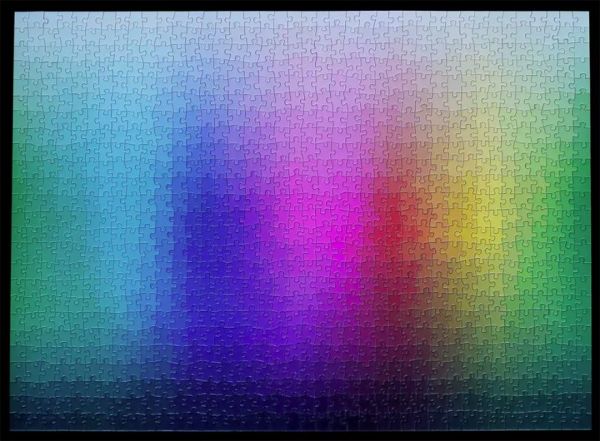
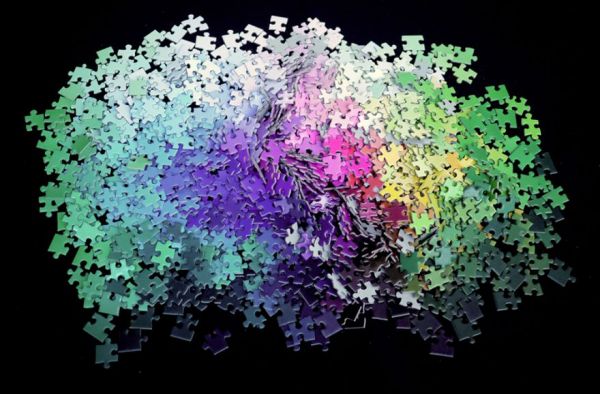
The video below shows enthusiastic hands sorting out a puzzle that has no defined pictorial image. Finding the pieces that go together is helped only by their closeness in colour value. The task, though still about shape and space, involves honing one's appreciation for the diversity of subtleties in the tonal mix.  There is a discovering of how things 'blend in'. 


The participants are not relying on things connecting clinically merely as many separate components. They are letting themselves experience the diversity of values available in relation to the whole. 


So too, given a pile of random stones, ever so gradually, we begin to sense the subtle differences of value within the entire range of viable options. As in many things in life we cultivate this ability through experience and learn to appreciate the value of the options presented to us.  


If the puzzle 'picture' was merely a random chaos of colour, or a completely white blank page, (to be solved spatially, with no other options) the hands still would likely find how all the pieces snapped together eventually. (Maybe not in the allotted test time). No doubt, when it was completed it would meet the 'standard' of what any 'correctly' completed jigsaw was, in that all the pieces were fitting properly. 

Working on the puzzle, and even after having put it together, the person may feel like it was worth while and even an admirable thing to have done, but would it necessarily be pleasing to look at? 

Conversations between positive and negative spaces can sometimes turn out to be arguments. 

I think it is more important to see the value of 'values' and allow for creative comparisons. 

Certainly, the activity of putting a puzzle together, and the process of building stone wall, are both more pleasing 'positive' occupations if the people who 'do' them have their values right.


Creator Clemens Habicht says the idea for the puzzle "came from enjoying the subtle differences in the blue of a sky in a particularly brutal jigsaw puzzle, I found that without the presence of image detail to help locate a piece I was relying only on an intuitive sense of colour, and this was much more satisfying to do than the areas with image details.

What is strange is that unlike ordinary puzzles where you are in effect redrawing a specific picture from a reference you have a sense of where every piece belongs compared to every other piece. There is a real logic in the doing that is weirdly soothing, therapeutic, it must be the German coming out in me. As each piece clicks perfectly into place, just so, it’s a little win, like a little pat on the back."