Tuesday, July 13, 2010

It was Henry Thoreau's birthday yesterday.


Is there anyone who studies or mingles or works with stone, who doesn't feel an affinity with lichen? There is a relationship there, which Thoreau aptly 'touches' on when he writes..“I seem to see somewhat more of my own kith and kin in the lichens on the rocks than in any books.” (Journal: 15 December 1841 Writings* Volume 7, page 296.)

It is as if we see something of our own nature and detect a hint of our distant origins in these natural 'living petroglyphs'.

Like our lives, lichen is a mystery. No amount of reading or research on the internet can adequately explain either away. We share a common lacy existence, clinging in marvelous manifestations to this our rocky planet – only on different scales.

All these crazy in-your-face colours jump off the surfaces of the rocks and bury themselves in the collective mind . The patterns have textures which like three dimensional fractals spread and overlap and curl upwards in layers like tiny pages of time itself.

Who could scrawl such appropriate graffiti on these sacred rocks and stones? Who could paint such convincing visions of the etherial? What hand could create such likenesses from nothingness and silence.

I foolishly hold my hand steady, paint brush poised and wait for inspiration and guidance. I hope to 'tune into' the beginnings of some new detail to this cosmic doodle. Perhaps the muse will show me, move me, teach me some small stroke, some decorative gesture, that I may add to this uncelebrated yet timeless work of art. Ah, but I see I will be here a long time. Try as I may I suspect I shall never understand the essence of such beauty. Ah lichen, what shall I liken thee to?


Monday, July 12, 2010

Invisible Fencing? - Contronyms/Part Two


Dry stone walling is often counter-intuitive and filled with ambiguous concepts . The whole thing seems to attract contronyms and contronym phrases. For instance, if you were talking to someone who didn't know anything about walling, you might say " It's important when you are building a proper dry-laid wall, that everything fits tightly. There shouldn't be any movement. No rocks, no wiggles, no loose stones. And if you are really filling the inside of the wall with 'hearting' properly, you really can't use too many stones.”

After hearing that explanation, they may well ask , "Are we talking 'invisible fencing' here, or what? "

The implications are transparent ( do you mean not visible at all or very easy to see ?) Dry 'stonewalling' ( purposely hindering any progress, or conversely, trying to be productive?) is the technique of building a dry stane 'dyke' ( ditch or wall ? ) with stones 'held' in place ( without anyone actually holding them there ?) in such a way that they 'stand' ( that would be placed 'up right' or lying down ?) in the wall with the 'joint's ( are these connections or separations ?) staggered so that the everything is 'bound' (on its way ' to' somewhere or staying in the same place ?) and remains 'fast' and secure (is that without any running joints?) all the time, not using any mortar ( glue to keep it together or exploding devices to break it apart? ) so that when it's 'finished' ( totally fallen down or completed?) and when people stand 'overlooking' one( peering at it or completely ignoring it?) they think to themselves, this is 'awesome' (beautiful or merely frightening ) especially the more it 'weathers' (withstands the elements or just crumbles away?)

Is it all that mysterious that people don't understand what were talking about? We tell people we are 'dry wallers' and then we explain right away that we don't do 'dry wall', and that we actually don't stay very 'dry' either! It's no wonder people wonder. Let's hope that despite all the ambiguities of walling terminology contained in the English language, eventually people will begin to understand what it is we do.

Sunday, July 11, 2010

Is it original?


Homonyms, acronyms, synonyms and antonyms....Just when you thought you’d figured you had them all sorted out, they come along with another category - contronyms. Some of you are shaking your heads and saying “tell me about it !“ and well, actually ‘tell me about it’ is a kind of contronym phrase. (Do you mean , 'I know all about it', or ' tell me what you mean' ?)

Contronyms are self-contradictory words . They are words that are their own antonyms, and they pop up all through our English language. They are not just pairs of words that sound the same and yet are spelled differently, ( having opposite meanings) like raise and raze or accept and except, but words that are actually spelled the same and by some weird evolution of our mother tongue turn out to possess two completely opposite meanings.

I first ran into the phenomena some years ago on a job where after weeks of restoring what was left of an old wall near Brooklin, Ontario, as we were just completing the work based on an old photo we had been given, a man came by and nodded towards the wall and asked if it was 'original'.

I didn't know how to answer him.

I began to pay attention, and started to notice other words that possessed this same bizarre quality of being their own antonym. For example the word 'bolt'. Is it to 'make immovable' or to 'move quickly' ?

Once I learned the proper name given to these words I discovered there were actually whole web sites devoted to contronyms. There were lists posted on the internet of words with completely contradictory meanings . I learned about obvious ones that I had somehow never thought about like ‘with’ - as in "I fought ‘with’ him at Gettysburg."

There were words like ‘left’ and ‘strike’ and ‘dust’ and 'reservation' (what you make when you know you want to go, and what you have when you are pretty sure you don't want to go). Some of these websites where organized so you could submit new words for eligibility in the growing list of posted covntonyms. I actually had one word accepted on one of these web sites. It was a word they overlooked. It was the word 'overlooked'. My example was... 'One of the first requirements, if they were going to buy a property was to find one with a beautiful dry stone wall on it. Later, they were prepared to overlook it.'

My wife is very disturbed by contronyms. She is the daughter of an English professor and believes words, though rich and complex in meaning, should by definition never have within their definition, their own opposite meaning. She gets very irritable when I come up with new examples of words with diametrically opposed meanings . These words seem to suggest a sinister parallel universe of flawed reality.

I sometimes bring the subject of contronyms up in social gatherings, like the time a few Christmases ago when I was actually explaining the contronym concept (contraception?) to someone while Christmas carols were being sung in another room, and someone shouted out ‘let's sing the refrain again.’ Refrain? (do it again or stop doing it?) hmmm.
Like searching for remnants of original dry stone ruins hidden somewhere off in the forest, I am always ‘on the alert’ for contronyms wherever they lurk unsuspected in the unconcious regions of the English language. It is fun to try to recognize a new one when it suddenly just shows up out of nowhere. I invite you to start your hunt for more of these sly elusive potentially, completely ambiguous words.
I will leave you with one of my recent favorites. The word ‘missed’ – as in 'I never missed reading my friend's blog.' Hopefully I have merely wetted your appetite for the subject. Fortunately, or not, 'You can't say too much about contronyms.'

And for that reason 'Contronyms Part Two' will be posted tomorrow.

Saturday, July 10, 2010

Put on a 'Happy Face'


There's nothing wrong with sitting on fence now and then, especially a dry stone one. When faced with opposing walling ideologies sometimes it's best to keep as many gates open as you can. This may necessitate rejecting the pressure to become a 'Course Mason' (one who builds in courses and badmouths those who don't) while still avoiding the structural mistakes of the random 'Cheek-end Warrior'.

A skilled waller will discover a middle path where pre-stacked palleted stone are not required for their walls to look proper and/or be 'politically correct'. They will also love what they are doing enough to always be trying to get better at it, but not at the cost of making the whole process not only expensive but onerous. They try to use the stones available to them, rather than be dependent on uniform-bed sized stones that can usually only be purchased from stone supply companies.
Like conscientious food consumers who prefer happy meat (meat that isn't factory farmed) these wallers prefer 'happy stones' - ones with natural faces, usually if possible found locally or salvaged or at least acquired inexpensively.

A processed or shrink-wrapped 'product' isn't the traditional stuff of 'authentic' dry stone walls anyway. Good dry stone wallers don't buy into the lie that stones need to be specially hand-picked, graded, squared, sawn or 'faced' before they can be used in a 'regulation' wall.


Quarries too, rather than casting off or burying stone 'tailings', are discovering a clientele in Canada who may not be able to afford modular stones suitable only for textbook walls, but will appreciate this less expensive walling material, which generally is of little value to those in the 'professional' stone industry. Frugal wallers know how to work with such 'leftovers' and don't require expensive 'high end' stones to build a good looking wall. They do magic with common stones because what they are building is not necessarily an 'industry standard' but the structural equivalent of damn good meal.

Friday, July 9, 2010

Green Thumbs-Up


People in Canada sometimes ask me if it is all right to plant things in a dry stone wall. It seems ironic that gardeners in Britain are often having the opposite problem, as they continually try to hack back the things that are constantly growing up on their beautiful walls. In any case, I tell Canadian gardeners that they can grow certain plants on top of a wall, if they lay down landscape fabric first and some soil,and they are prepared to experiment a bit. Rolls or clumps of sod can often work well. Norman Haddow tells me that in Scotland these are often called turff top walls.

And of course you can grow all sorts of greenery at the base of a wall, to soften the look of the stone wall , as long as you watch that they dont grow to big and start doing damage. A dry stone wall or garden feature that has plants growing along the base of it nestles the stonework beautifully into any garden setting. Flagstone butted right up to a dry stone wall, on the other hand ,never looks as attractive. Perhaps it is just the look of too much stone material, but often it seems much more effective to create a contrast at the base of a wall by having greenery growing right up to the stones

Until two years ago I hadnt thought of another alternative for introducing plants into walls effectively.

The problem has always been frost (and to some extent, erosion too) in our part of Canada anyway. Soil will expand and contract with freeze thaw cycles and compromise the structure because the stones in the wall (whether intentionally or not) are often depending on the soil for support and eventually everything starts to move. Walls will deteriate quickly if they have soil or sand or anything that holds moisture in side them, because of frost movement indside the wall and the washing out that happens due to erosion. Dry stone walls can accommodate the movement of frost in the ground they are built on, but not the dirt they are built of.

While it is definitely not a good thing to put soil right into a dry tone wall there is a way around it.

By constructing small exterior cavities or niches in your wall, you can then fill these nooks and crannies with appropriate small plants, which have had their soil/root systems wrapped in landscape fabric or even better old nylons, to keep the soil from washing out and/or then causing damage to the interior of the wall.

Some things we planted two years ago this way, still had a hard time growing, tucked into their new rocky 'cliff-like' location, but recently we have had some success with certain sedum, thyme plants, as well as my personal favorite, chives.

Thursday, July 8, 2010

Hands-on Garden Construction


Signs like these are not just humorous but often much needed disclaimers. A property, when it is being 'landscaped', too often looks like a major renovation with all the associated angst. And then there's the destruction connected with such an undertaking, which may well result in a funeral for many beloved plants. Clients are taught to expect a mass burial of most of the flora around any construction being done on or near their garden.

But is it right to give up on the idea that your garden can look good through the transition period, what ever the scale or the length of time? Just like children, gardens can and need to be appreciated at any stage in their development.

We just finished 40 feet of wall which surrounds a raised berm garden. We brought in over 15 tons of stone material. We didnt use a bobcat or noisy dusty power tools. We tried to be careful around the plants and shrubs while working. It wasnt difficult. It's how we like to work anyway.

At the end of a week of 'hands on construction' the new wall looks like it has always been there, and the surrounding property remained undamaged. The upper 'under construction' photo shows about as messy as it got. The photo below it was taken not months later, when everything had time to heal over, but yesterday, the day we finished the project.


Wednesday, July 7, 2010

Getting our hands muddy.


For the last two days we slogged in the hot muggy day preparing the base for the bridge we will be building at the Canadian Dry Stone Festival at Landon Bay. Landon Bay is on the 1000 Islands Parkway near Rockport Ontario. It is a biosphere reserve run by Parks Canada and part of a bigger geologically and ecologically diverse area called the Frontenac Arch. A few months ago we built a special arch outside the Biosphere Reserve Center just down the parkway. Now we are looking forward to adding a bridge.

We had to dig with shovels and then with our hands in the mud until we found bedrock by removing all the loose sediment. Then we wrestled a number of huge stones around to be able to start building the two piers for the 12 foot span bridge we plan to complete on the 4 days of Rocktoberfest coming up on Oct 8, 9,10,11 on the Canadian Thanksgiving Weekend. We are using a sandstone material that has been stored on the Landon bay property for many years.


The bridge will span a small creek which is a tributary of Halstead creek which flows into the St Lawrence. The bridge is to replace an old wooden bridge which we first had to take down and carry off the trail. The new dry stone bridge will be built by a team of wallers from all over Canada. It will connect a hiking trail that runs along the west side of the park and is part of a network of interesting nature trails throughout the park.


John Macleod who works at the park, and is involved organizing the many outdoor nature programs at Landon Bay is excited about the new bridge which will hopefully be a stunning addition to the park. People will be able to see it being built from higher up on Cross Cemetery Road which runs parallel to the forrest and the stream just west of where the new 'festival bridge' will be built.


Photoshop rendering of how the new dry stone bridge will look from the road.

While we were having lunch John told us enthusiastically " The view from the road presents an excellent vantage point for people to appreciate how the bridge is built, especially elderly people who might not normally walk such a long setion of trail to be able to see it."


Tuesday, July 6, 2010

Holding On To Time.


The Dry Stone Waller Walling in the Small Town Cemetary


In rising walls I spy a giant coffin

for a late, open casket wake where god

weeps over "wife Jane taken from child"

though, in old maples' roots, nourished by de-

composing caskets' remains, I too spy

"newlyweds who died in honeymoon fire"

re-incarnating into leaves with such view

of Lake Winnipesaukee that they, too,

possibly divine God's grand design in

these brief lives of living on so much light,

and so I celebrate the fallen leaves returning,

in spring, as iris that--peering over

the wall--turn this coffin into a cradle

ever so gently rocking my joy awake.


*First appeared in Poetry East Magazine, Fall, 2007 and in The 2008 Poets'

Guide to New Hampshire


STONE BY STONE, POEMS ABOUT THE ART OF DRYSTONE WALLING

Anyone who has ever been lost in the vast woods of northern New England knows what a blessing it is to happen upon a stone wall, that vestige of work done by human hands a couple of centuries ago. To follow those stones means you'll come out somewhere, that wall in the woods your compass to home.


In this wonderful collection of poems, Dennis Camire leads us, Stone by Stone, from the elemental to the ethereal, from chipmunks to transubstantiation. He is a sure-handed Virgil, as deft with syllables and sounds as the wall builders with stones, on this imaginative journey from the dark woods of our times to the warmth and humor of his hearth.


--Bruce Guernsey, Editor, The Spoon River Poetry Review--


Dennis Camire has created a book of wonders and transformations, making from stones and the work of stone wallers his own marvelous poems. Stone by Stone is nothing less than a beatific vision of work, where maker and material are in harmony, and craft grows out of that fine tuning. Part of the wonder is the way these poems cover such a range of time and knowledge, from the scientific to the mystical, from the long millennia during which stones solidify, break down, disperse, and re-emerge, to the present moment a waller holds one stone in hand and sets it in place. These poems embody mystery, rock-solid and profound. The music they make is sure, and like a fine stone wall these poems reward every moment we spend musing in their presence.


---Betsy Sholl, Maine State Poet Laureate, author of "Rough Cradle," Alice James Books--


To purchase a copy of the chapbook, log-on to www.finishinglinepress.com and

Click “new releases.”


Dennis Camire's poems have appeared in Poerty East Magazine, Spoon River Poetry Review, The Mid-American Review and The 2008 and 2010 Poets' Guide to New Hampshire. Currently he is a bartender, a part-time adjunct instructor at YorkCounty Community College, and the executive director of Maine Poetry Central which curates the Portland Poet Laureate Project and the Minute with the Muse video series which was recently awarded a Maine Humanities Grant. His last chapbook, "Unidentified Flying Odes," was published by Moon Pie Press. To contact him for readings and anything related to literature, email him at bioluminescing@yahoo.com


Monday, July 5, 2010

Creating 'Firewalls' With Both Hands


I first met Matthew Ring about 6 years ago at a dry stone wall workshop I taught north of Cobourg, Ontario. He was one of those people who whenever they set their mind to it, just 'get it'. His walling abilities shined from the first stone he picked up and his enthusiasm was infectious.

He went home from the weekend totally excited about building dry stone walls and a week later phoned me to ask where he could get 24 tonnes of stone inexpensively for a project he was going to do in his front yard. When I went to see the wall two weeks later I was a little dubious about how it would look.

It was beautiful, and sturdy and quite well built. I asked him if he was concerned about vandalism since he built it so close to the sidewalk in a busy residential part of Oshawa. He told me many of the kids in the neighborhood came around and after watching him build the wall for a while, were invited to help out bringing hearting and sorting stones on his lawn. He said they really enjoyed getting involved and he appreciated their help.

"These same kids now take ownership of this wall. They are not going to allow anyone to come along and mess with it." he told me proudly.

One year later, after a couple more workshops and helping us with some Highland Events in Ontario, doing demonstration walls with the DSWAC, Matthew took his intermediate certification test during the first Canadian Dry Stone Wall Festival we held here in Port Hope, Ontario in 2009. He was tested by two good friends, Norman Haddow and Dave Goulder, both certified testers with the DSWA of UK.

Matthew passed it in flying colours and became the first intermediate accredited waller with the DSWA in Canada. He helped me after that on many interesting and challenging projects, including a very tricky 10 foot high 'Cheese Wedge' structure we built at the Niagara Horticultural School, behind the Butterfly Atrium at Niagara Falls. Occasionally he helps out teaching beginner workshops.

On the other hand, Matthew is actually a highly qulified I. T. guy, as well. 'It' stands for information technology: the branch of engineering that deals with the use of computers and telecommunications to retrieve and store and transmit information. Basically he spends a lot of time and hopefully enjoys figuring out computer related internet, stuff, which I can't begin to get my head around. Nearly three years ago he kindly helped us set up the new DSWAC web site, which has been a tremendous success in networking with wallers all over Canada. He continues to be our main source of help solving annoying website glitches and undoing the various website messes we get ourselves into at the DSWAC because of a basic lack of programming knowledge.

It seems appropriate to post a picture of a beautiful, and completely functional, 'fire wall' which Matthew created a few years ago at his property in Guelph Ontario. Matthew handily straddles both worlds, that of computers and dry stone walls. He is an inspiration to his peers in both of these pursuits. It occurred to me that there are a words too, where the terminologies used in these disciplines straddle both the world of walling and of computers. Although 'fire wall' describes two very different things, I suspect the expertise and skill needed to figure out how to design and create them is very similar.


His web site is...http://matthewring.ca/

Sunday, July 4, 2010

Discovering the link to Past Times and Pastimes.


Here is a link to an article by Ray Yurkowki a writer with Way Back Times, which I discovered yesterday while looking up 'dry stone walling' on the internet. I remembered Ray had come and interviewed me last December and said he was going to let me know when the magazine issue came out with his piece in it. Though I didn't hear anything more, an interesting looking link appeared on the Google search results and surprisingly it turned out to be Ray's article.

Web surfing, like walling, is just finding and forming interesting links .


http://www.waybacktimes.com/stonewalls86.html

Friday, July 2, 2010

Ham and Handiwork on Canada Day


Dry stacking stones lends itself to many applications. I am grateful to have been able to build many of them over the last 20 years - beautiful functional walls and terraces, benches and tables, sculptures, follies, stone huts and vaulted buildings, and occasionally bridges. Having just revisited the dry stone oven we built just last month at the big Canada Day celebration at the Chrystian farm near Grimsby Ontario, I am happy to report that it worked perfectly and that dry laid bake ovens can be added to the list of stone creations that not only are structural and look good, but also work surprisingly well.

The annual party held outside in a pear orchard on the Niagara Escarpment overlooking lake Ontario was hosted by Dave Chrystian the main chef at Victor's at Hotel le Germain in Toronto. He and several helpers in the food industry provided a wonderful afternoon (and evening) of food and entertainment as a way of saying thanks to the many suppliers and their families who he has got to know at Victor's Restaurant.

The quaint looking dry stone oven, it turns out, was the main attraction. David told me he started a fire in the oven at 9 am ( charcoal briquettes and then chunks of oak firewood) Six huge legs of prestigious Berkshire pork ( provided by Black Bow Farms in Southwestern Ontario ) went in the oven and cooked all day at a steady 300 degrees.


At 4:30 when we arrived the pork was almost ready and smelled delicious. Dave gave us a peek inside.


A crowd had already gathered to watch the action.


At 5:30 David's assistant Alex Tso carefully removed two of the legs which looked to be done, and then put in a tray of about a dozen good sized shanks of lamb. Jimmy Giggie of Wild Organics started cooking arctic char ( not from the Arctic but up the road in Ceemore Ontario, no less) which he had donated to the cause.


He used the special stone bbq we had built into the counter on the side of the oven to cook rack of lamb too. David skillfully cut up the meat and placed it on serving trays with scallions as people watched.


Everyone who came to the event brought an array of yummy side dishes to share. The meal was delicious and the meat was particularly tender and tasty. In the evening there was live entertainment and of course a fireworks display on the side of the mountain. Well done David another great event and thanks for inviting us to see your new oven in action.

Thursday, July 1, 2010

Saluting the flag.


It seems appropriate to honour the flagstone industry today by combining the flag of Canada with the 'flag' of patios paths and pool surrounds. Most wallers, masons and landscapers in Canada have at some time or other had to do flagwork. Often this kind of work is where they first start out handling and shaping natural stone. Later they might go on to build stone retaining walls and traditional free-standing dry stone walls, or they may just stay with it as a full-time occupation. With their backs to the burning sun, awkwardly crouched down, painstakingly shaping and chiselling the contours of the stones so that the joints are all a consistent width, ( and with no ugly 'sawn' edges ) many a patriotic flagstone 'craftsperson' has helped raise the standard of flagstone across the nation.

'Flatwork' is a term used for doing phony flagstone, out of poured concrete that has been stamped and then stained. Sounds awful, doesnt it? Contractors are trying to make it look like real flagstone, but eventally, after time, it looks like what it really is - a manufactured aggregate portland cement product.

I like to think that doing the real thing in a garden with natural flagstone creates a much higher standard.

In terms of actually raising the flag material, we have done that too. Here is a clip (below) of dry stone 'wallers' from all over the world raising a large piece of flag at our Canadian Dry Stone Wall Festival last year. The thick 6 inch slab of flag was slid up and over, to be used as a lintel stone over the window of the traditional dry laid Scottish Blackhouse we completed over the three day 'Rocktoberfest' here in Canada. This October we will be building a dry stone bridge over a babbling creek near 1000 Islands at Rockport Ontario in Landon Park on the Canadian Thanksgiving weekend.

Meanwhile this Canada day we should stand and raise our 'hands' to salute the men and women who are laying flagstone every day and laying it properly. When it's done right it can look beautiful and last for many years.


Wednesday, June 30, 2010

Getting a handle on arch-door openings.


I have built many arches over the last 10 years. I did quite a few roman arches before I did my first gothic one. That was in collaboration with Dan Snow in 2005 at the second Canadian dry stone festival in Port Hope Ontario. We had a heck of a time trying to figure out what the correct angles for the vousoirs would be. He admitted that it was his first gothic arch too.


Dan took a while and figured something out and drew some lines for us on the wooden form, where he thought they should be, but as we built over it we realized the guide lines were not looking like the correct angles at all.

When Im building a 36 inch wide arch, I still use that form sometimes and smile when I look at the old pencil lines drawn on it. Gothic arches, it turns out, are actually a bit easier to construct and as far as I can tell produce a much more stable structure than roman dry stone arches. I build mostly gothic arches now.


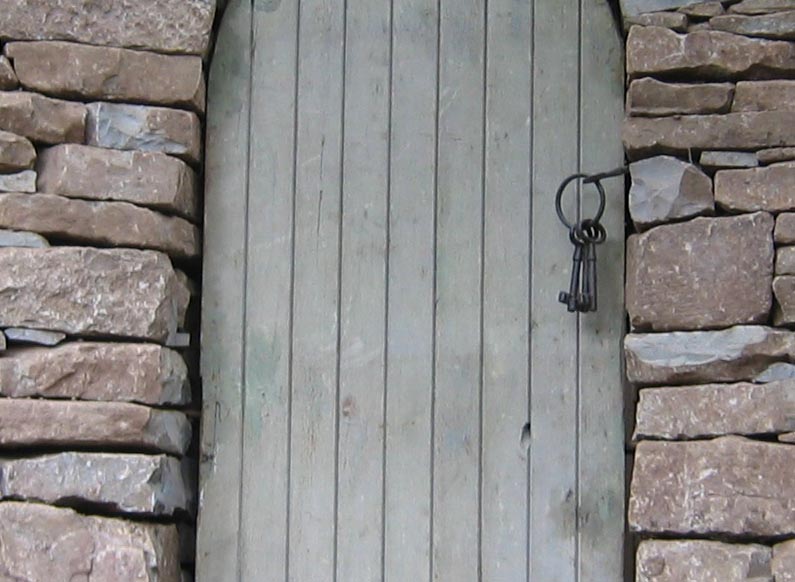
Sometimes a client wants a door in an arch I will be building them. Most of the time they are for decoration, as this one in Oakville, Ontario. Actually the door was the form in this example. ( It was doubled up and had plywood bent over the top to support the stones). We lowered it an inch after the stone arch was built, and left it there to look like a door. It didn't go anywhere. (Neither the door, nor the arch)


Speaking of not going anywhere, many of the doors to the arches I have built don't have handles, as is the case with this one above that we built in Uxbridge Ontario in 2008. They don't need door knobs if they are just decoration. They often have keys though, which is kind of amusing.


In a Gothic opening if the door is actually going to be used and is to open properly at all, it needs to be hung flush with the outside or inside wall (the pintles can't be located in the middle of the wall), otherwise the top of the door catches on the top of arch (unless the door is hung much lower) Who knew? These are little things you discover as you go. Sometimes you find out the hard way.

Below is a door we placed in an arch we built for Mariposa Gardening at the 2009 San Francisco Flower and Garden Show. I borrowed the door from a vendor at the show who had several rustic hand-made doors on display. We met up during the show and decided one of his doors would look good in a photo standing inside the arch. This door has a handle, but clearly doesn't have hinges....... It's held there by 'hand'.


Tuesday, June 29, 2010

Hand-Breaks.


I have to confess that I don't know my next door neighbour very well. I have yet to learn his name (first and last) and have no clear idea which of the many people of ages who come and go actually live there.
On the other hand, I am certain I know more about his professional life from the endless parade of trucks and cars that arrive broken (and muffler-less) and disappear after a few days spent hidden in the plastic portable garage that takes up so much of the driveway, that everyone has to park on the lawn.
Repairing vehicles is a year-round pursuit but summer time brings out what I take to be the neighbour's real passion so now the place is packed with seriously dented, heavily reinforced sedans whose gas tanks sit proudly in the back seat and whose windshield and door glass is long gone.

I try to see all this in a positive, creative light.
While I was building the dry stone tree sculpture on our property last weekend (see July 28 entry) my neighbour spent Saturday and Sunday a rather different way. He towed his car somewhere and entered it in some sort of demolition derby. I guess we both spent our free time smashing things with our hands, me rocks, him cars. The similarities end there. My new tree installation, set back nearer the house, can only be seen by people who come up our driveway. His car, 'Demo Demon' (written in yellow dribbly letters) sits on a trailer behind his truck in front of our property right on the street for all to see.
Actually this is where he always parks his trailer and truck and it continues to be a bit of an eye sore. Today it looks more like two eyes sores! The poor bashed up car and grimy trailer have been parked there all day. I'm guessing they will be there for a while. In my desperation to see this in a creative reflective light I decided it deserved a photo (and a blog post).

The nice dry stone wall in the background is mine. It was built a few years ago partly to make the front of our property look pleasing from the road. I was wondering about asking my neighbor not to park there. But I probably won't.

Monday, June 28, 2010

Handy dandy obelisk.


I built a dry stone tree today. Well, it is more like a truncated tree with 6 cut off limbs. It's over 8 feet tall. I was inspired to build it after I came across a few longer stones ( that I thought would make good 'branches' ) and had put aside for just such a tree sculpture. One stone had a particularly nice curve to it. By placing another long 'double-branch stone' over it for weight, I was able to place it in the trunk, curving upwards, like a branch.

The trunk is about 2 feet in diameter and in fact the tree is built on the stump of a rather large ( 70 feet tall) pine tree that our son Robin the arborist handily cut down for us last month, because it was very dead and dangerous. Below is a clip of him cutting it down.

In the photo above Mary is seen planting a newly purchased, fragrant, climbing Hydrangea at the base of the stone tree. She wanted me to build her an obelisk for it to grow up on. I'm not sure what I built is exactly what she had in mind.

Anyway, now we have a stone tree as a monument commemorating the 70 foot pine tree, erected on the very site where it once grew.

Sunday, June 27, 2010

Hand to hand combat.


There is a growing battlefield out there. Fields and gardens in our area (Southern Ontario) are being invaded by a insidious green enemy: Dog-Strangling Vine or Black (or Louis’s) Swallowwort (Vincetoxicum rossicum or Cynanchum louiseae).

It reproduces by seed and also by runners under the soil. In the wild, it sneaks up and begins to twine itself over shrubs, trees, beloved perennials and peace loving wildflowers. About this time of year, it blooms with seemingly insignificant pinkish-brown flowers but once fertilized, the plant makes narrow pods that will later release milkweed-like puffy pods and burst with airborne seeds when the time comes. Unsurprisingly, it is a cousin of the common milkweed. However this enemy is proving to be almost unstoppable.Trying to yank it up through weeding can cause breaks in the root system -- and each break can encourage a new growth top. It can cover large areas in a frighteningly short time.


The energy, discipline and hard work needed to build beauty into our gardens are the sane qualities needed to stop such a focused and insidious foe as Dog Strangling Vine. Like any serious battle, we need to marshal our resources. The best, most earth-friendly thing to do is to cut the stem(s) off at, or just below, the soil level. Repeatedly mowing over throughout the growing season will eventually wear the plant out but farmers and forest managers are dealing with thousands of hectares where a home lawn mower simply won't do.

Will a well built dry stone wall hold back the botanical deluge? Probably not — though I have clients willing to find out. Walls of stone can be the demarkation zone between lawn and bushland, garden and wilderness, or just your proeprty and the neighbours. Weeds and other garden enemies tend to quickly occupy any well intended buffer zone, so eliminating the no man's land with a wall is generally a good idea. An engineered wood or wire fence will not do as good a job and will definitely not look as nice. Stone walls give the landscape less of a modernday 'battlefield' look. They add character and create a sense of time and place to the battlezone which at least makes it seem more like an historic re-enactment.


Saturday, June 26, 2010

Hands-On/Cobwebs-off


Do you have an exciting web site? It doesn't have to be a site for sore eyes, but it should change once in a while! It should do what it purports to be. Pictures should help tell an interesting story, not gobbledegook words or just more of the usual industry jargon. It needs to at least attempt to justify its existence in the vast ocean of cyberspace fecundity. It could give the impression that it is worth visiting more than once, or at all. It should not be boring.

It might be best to be a hands-on site, one where people can interact with what has been posted and allow some sort of 'flow' to the material being presented as significant. It should give good information and accommodate replies and offer responses to topical issues that the creator claims to be interested in. It requires an accountability and a continuity.

It should be like a flowing well-built dry stone wall. It should look nice and be structural, but also have a reason and purpose. It should be supporting and be supported. Where there are gaps, they should be addressed and fixed. Where there are weaknesses, they need to be mended, rather than let the typos, misprints, dead links, empty pages, and missing follow-up reports of events and discussions go unchecked, unattended and uncorrected. Such websites, like stone walls, shouldn't be allowed to clutter up the virtual landscape. Even though it's called a web site, catching and boring unsuspecting visitors to death isn't how it is supposed to work. We need to be inspired, or at least left with enough energy to move on and visit better sites that have more thought and care put into them. An unloved, cobwebbed site, like a badly built, crumbling wall, needs to be taken down. Whoever is responsible for creating it shouldn't just leave it there on the www.doorstep like an abandoned child.

Friday, June 25, 2010

Handwriting


Just like handwriting, every waller has a style of building. Just by looking at a wall it is sometimes very obvious who built it. There are signature combinations of stones. There are clues in how much the stone is worked, how the coping is done, whether there is a lot of straight coursing or not, or if the pattern it is broken with jumpers and a lot of random sizes. There are the tell-tale fittings of interesting contours, the attention to detail, the funkiness of the shapes and the overall design of the wall. Of course the standard of workmanship is the best indication of who built the wall.

When I was in Scotland two years ago I thought I recognized the waller who had done some exceptional repairs to some walls we discovered near Drummond Castle Gardens. It turns out I was right. Mastercraftsman and waller Norman Haddow was the one, and he was quite chuffed that we had come across these walls and identified them.

Anonymity and monomorphism within a region or locality is more often the other 'norm' I suspect, as individuality in Britain, with walling in general, is more likely something to be frowned upon.

While I am getting good at recognizing Norman's handiwork, Im not sure I could always recognize his gloves. Here is a picture of them drying out on some batter poles- a shot taken by his host when he was in Italy.


Back here, across the ocean, there are very few dry stone wallers. They have their signatures written in the walls they build. There is room for walling to be thus, here in this great land of Canada, where there is enough space and freedom for people to grow and develop their art as well as their skills.